


Stablecoins have gradually and quietly become one of the most powerful payment networks in the world, facilitating the transfer of billions of dollars via blockchain, continuing to solidify their role in the global financial sector.
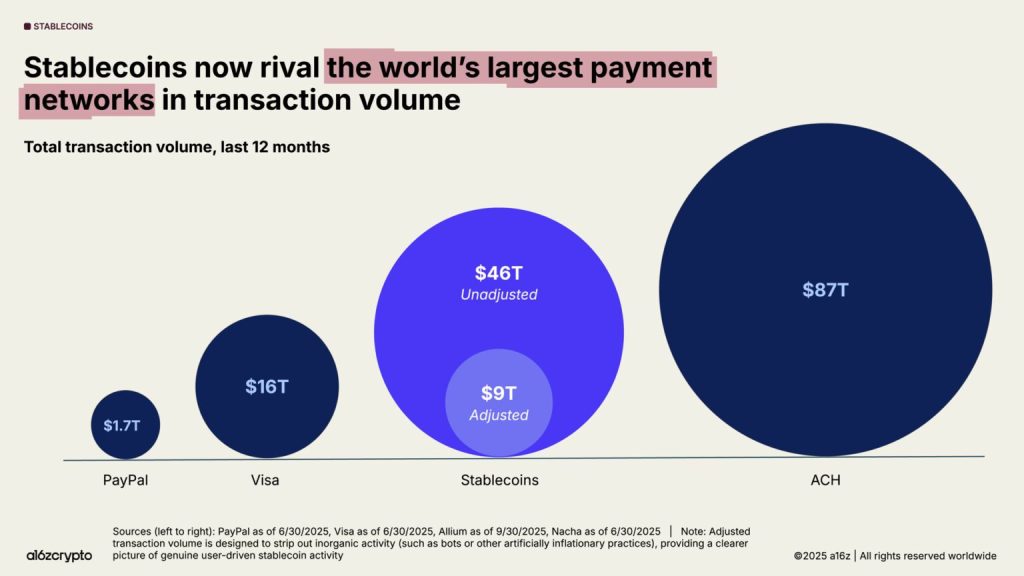
According to the “State of Crypto in 2025” report released yesterday Wednesday by Andreessen Horowitz, these digital currencies processed transaction volumes totaling $46 trillion over the last year, an increase of 106% from the previous year. The report describes stablecoins as the clearest indicator of the crypto sector’s maturity this year. Even though the total volumes include rapid financial movements and not just individual transactions, the numbers are still quite astonishing.
A16z: stable transaction volumes close to automated local transfers (ACH)
Current stablecoin transaction activity is approaching the volumes of the U.S. National Automated Transfer (ACH) Network, which represents the electronic backbone of the U.S. banking system.
Since most direct deposits, payrolls, and bills are processed via local automated transfers (ACH) through U.S. banks, this achievement indicates that stablecoins are beginning to operate at a level similar to the infrastructure supporting traditional financial systems.
After excluding bot transfers or automated activities, stablecoins processed $9 trillion in payments over the past 12 months, an 87% increase from the previous year. This level represents more than half the volume of payments made via Visa and more than 5 times that of PayPal.
Structural growth signals a shift from speculation to everyday use in global markets
In previous years, stablecoins were primarily used to settle crypto transactions. Today, it has become one of the fastest, cheapest and most flexible ways to transfer United States dollars (USD), and transfers using stablecoins are often settled in less than a second, at a cost of less than a cent. Therefore, the report describes it as “the backbone of the blockchain economy” as it carries out financial transfers, international payments and decentralized financial services.
Tether-USDT and USD Coin-USDC dominate 87% as digital dollar usage on blockchain rises
The rate of use of stablecoins continues to grow strongly. The average monthly trading volume using them reached an all-time high of $1.25 trillion in September 2025 alone, showing momentum independent of speculative cryptocurrency trading, and A16z said this trend suggests strong structural demand and growing real-life usage.
The supply of stablecoins has also increased to unprecedented levels, surpassing $300 billion, and the two stablecoin industry leaders – Tether and USD Coin – account for approximately 87% of their circulating supply.
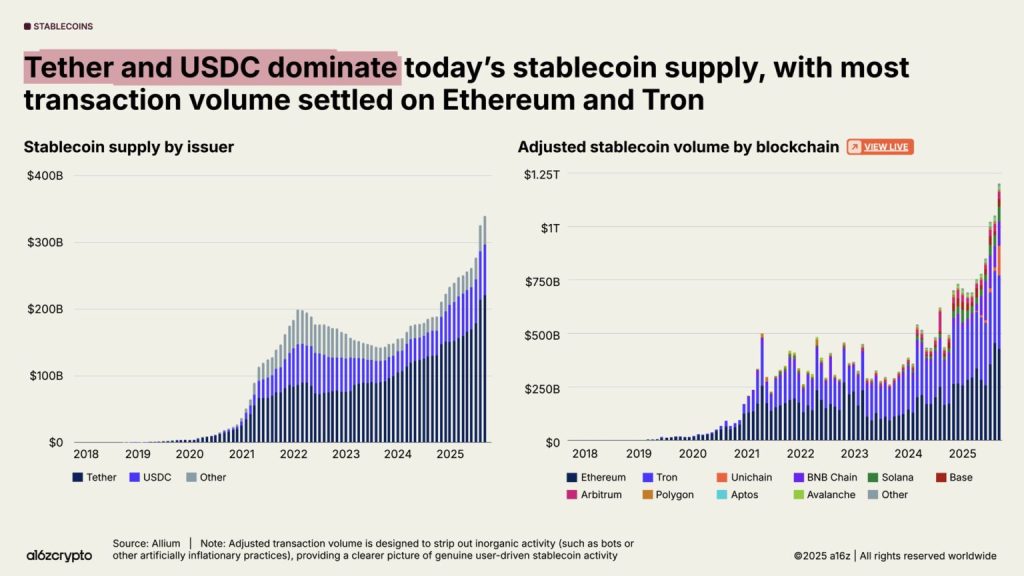
The Ethereum blockchain and the Tron blockchain remain the leading pair of settlement networks for stablecoin transactions, having processed approximately $772 billion in stablecoin transactions in September, approximately two-thirds of the global volume.
Although the stablecoin industry is dominated by these two blockchains, new issuers and networks are gaining momentum as developers strive to create stablecoins tied to the value of local currencies based on region-specific trends, which will expand the stablecoin industry beyond US dollar-denominated assets.
A16z data shows that stablecoins are now an influential macroeconomic force; More than 1% of the total circulating supply of US dollars is now available as digitally represented currencies on public blockchain networks.
Stablecoin issuers currently rank 17th among holders of U.S. Treasuries, up from 20th last year.
U.S. Treasuries represent more than $150 billion in stablecoin supply-equivalent reserve assets held, with their combined issuers now ranking 17th among holders of U.S. debt securities, up from 20th last year, and ahead of the holdings of many sovereign countries.
This comes at a time when foreign central banks are reducing their appetite for buying U.S. Treasuries and increasing their gold reserves for the first time in three decades, and even with weak global demand for Treasuries, stablecoins are spurring renewed demand for dollar-denominated assets.
Since the majority of stablecoins are pegged to the value of the US dollar, this strengthens the latter’s position as the global reserve currency. The A16z report expects the total value of the stablecoin sector to grow nearly 10-fold, surpassing $3 trillion by 2030.
The report concludes that stablecoins – previously a tool to facilitate trade – have now become a fundamental pillar of digital financial systems, as they provide a bridge between traditional financial systems and blockchain networks. For the first time, it began to compete with the giant payments companies that shaped the modern financial era.
The post-A16z Report: Payment volumes using stablecoins will record $9 trillion in 2025, continuing to chase away giant payment institutions such as PayPal and Visa appeared first on Cryptonews Arabic.

