


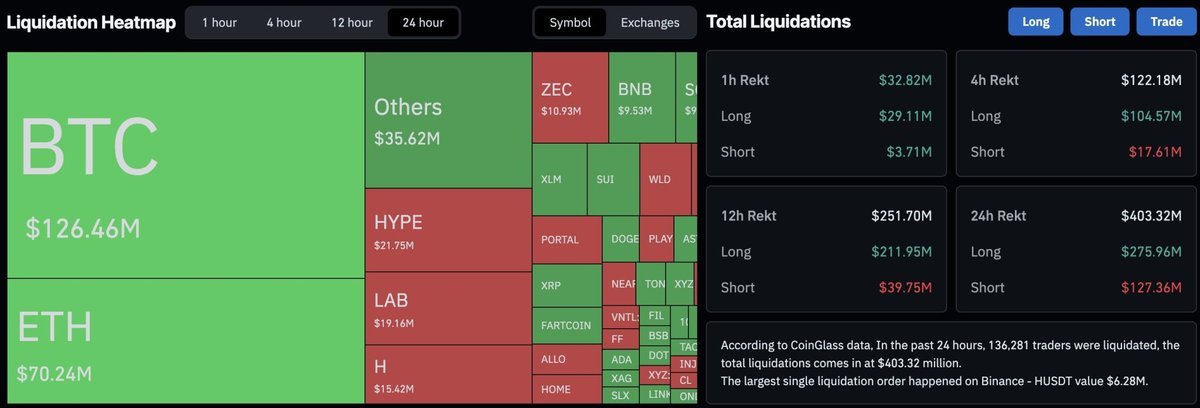
In today’s Bitcoin news, the BTC currency was subjected to a strong shock that led to its decline from the $73,500 level to a low of $71,500 on June 1, immediately after the news of mutual strikes between the United States and Iran spread. This news led to a massive wave of risk-free selling that swept the crypto derivatives markets.
In a span of no more than four hours, more than $400 million in leveraged long positions were liquidated, with the Binance and OKX platforms absorbing the largest blocks of forced closure of these positions. This decline confirmed what previous events have proven time and time again: that the combination of excessive debt and geopolitical shocks is a devastating combination.
Bitcoin News: How did the US-Iranian strikes turn into a wave of liquidations?
The mechanism of transmission of the effect was quite clear; Headlines about the strikes prompted investors to reposition their portfolios away from risk in various asset classes. As crude oil surged more than 5% and gold approached record highs, capital moved away from riskier assets such as Bitcoin. BTC’s association with Nasdaq instead of gold during this period weakened the “digital gold” narrative that was prevalent in 2025.
In the derivatives market, rising open interest in Bitcoin futures has made long positions vulnerable. The US-Iranian strikes acted as a negative catalyst, leading to forced liquidations across all platforms with key price levels such as $72,200 and $71,800 breaking, exacerbating the decline.
Data on flows to exchanges showed a sharp increase in activity by short-term currency holders who moved their assets either to hedge or exit the market, while long-term investors remained inactive, suggesting that there was a purge of speculators rather than a collapse of fundamentals. Data from CryptoQuant had already warned of the structural fragility of the market before the geopolitical event triggered the decline.
Can Bitcoin price recover or does $71,500 pave the way for a deeper fall?
The damage caused to the price of Bitcoin goes beyond just a temporary drop; Breaking the 50-day moving average and losing the psychological level of $72,000 in a single session moves the technical structure from the accumulation phase to the distribution phase. Immediate support now stands at $71,500, with more protection around the $73,000 area, an area that absorbed selling pressure during the leveraged deleveraging wave in February and March 2025.
Outflows from ETF funds also helped reinforce the pessimistic outlook, with spot Bitcoin funds in the United States seeing net outflows estimated at $2.97 billion as asset managers turned to defense. BlackRock’s iShares Bitcoin Trust (IBIT) recorded one of its biggest outflow days since its launch.
This is an important indicator; An outflow of money from an IBIT fund of this magnitude means that even the most liquid ETF capital is not immune to a reassessment of geopolitical risks. This repeats a trend seen in early 2025, where political and geopolitical headlines caused sharp declines in the price of BTC, regardless of technical fundamentals.
For his part, fund manager Michael Cramer of Mott Capital Management believes that US dollar liquidity conditions remain a structural constraint, warning that large Treasury regulations remove the excess liquidity that speculative assets such as Bitcoin depend on. If this liquidity pressure persists, along with existing tensions in the Middle East, the near-term outlook for Bitcoin price will remain bearish.
Here are the three expected scenarios compared to current levels:
- Optimistic scenario: Easing geopolitical tensions over the next 48-72 hours could trigger an offsetting recovery; With ETF flows resuming and BTC reclaiming $73,000, testing the 50-day moving average as support, opening the way to $75,000.
- Basic scenario: Bitcoin stabilizes in a range between $71,500 and $74,000 as leveraged positions are liquidated and public opinion stabilizes; The recovery is slow and limited by cautious flows into ETFs and pressures on dollar liquidity.
- Pessimistic scenario: Military escalation in the Middle East leads to second wave of decline; With the $70,000 level failing, $68,000 becomes the next test, and continued ETF outflows could push the price towards the $63,000-$55,000 range seen in Q1 2025.
The structural market reading remains bearish unless the $73,000 level is reclaimed at the close, and any movement below this level remains within damage control attempts.
The post Bitcoin Falls to $71,500 After US-Iran Strikes appeared first on Cryptonews Arabic.

