


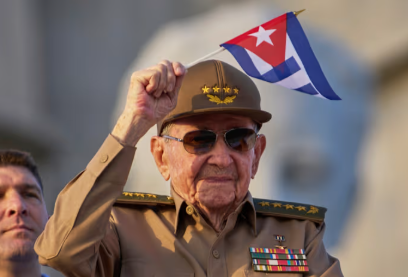
The claims, which have not been independently verified by all international authorities, suggest that Cuban authorities may be preparing civil defense measures in anticipation of a possible escalation involving the United States. The event has drawn immediate attention among global analysts due to the historical sensitivity of US-Cuba relations and the broader implications for regional stability in the Caribbean.
If confirmed, the reported distribution of firearms would represent a significant change in Cuba’s internal security posture and civil defense strategy, reflecting heightened concerns about external threats and geopolitical uncertainty.
The situation quickly attracted global scrutiny due to the strategic location of Cuba, which lies just 90 miles off the coast of Florida and has long been a focal point in Cold War-era tensions between Havana and Washington.
Cuba and the United States have maintained a complex and often tense relationship for decades, marked by political disagreements, economic sanctions, diplomatic restrictions and historical conflicts dating back to the Cuban Missile Crisis in 1962.
Although relations between the two countries have experienced periods of limited normalization in recent years, underlying tensions remain, particularly regarding sanctions, regional influence and ideological differences.
Recent reports suggesting the distribution of firearms among civilians have raised concerns among international observers about the possibility of further escalation in an already sensitive geopolitical environment.
Security analysts note that civilian arms programs are often associated with national defense strategies in situations where governments anticipate potential external threats or internal security challenges.
However, details regarding the scope, scale, and official confirmation of the alleged distribution are still unclear at this time.
Cuban authorities have not issued detailed public statements confirming the alleged mass distribution of firearms to civilians in preparation for a possible US attack, and independent verification by international monitoring organizations is still pending.
Despite this, information has spread rapidly through digital platforms, fueling speculation and debate about the current state of relations between the United States and Cuba.
The U.S. government has not released any official response addressing specific claims about Cuba’s alleged civilian arms measures.
However, Washington and Havana have historically maintained cautious diplomatic engagement, often balancing periods of limited cooperation with renewed political friction.
The Caribbean region remains strategically important to global trade routes, maritime security and regional political stability, making any escalation between major powers a matter of international concern.
 |
| Source: Xpost |
International relations experts emphasize that even unconfirmed reports of military preparedness or civil mobilization can have significant impacts on global perceptions, financial markets, and diplomatic activity.
In similar historical cases, geopolitical uncertainty involving major nations has often led to increased attention from defense analysts, political institutions, and global security organizations.
The reported developments come at a time when global geopolitical tensions are already high in multiple regions, with ongoing conflicts and strategic rivalries influencing international stability.
The security dynamics of the Caribbean are particularly sensitive due to the proximity of key maritime routes, trade corridors and strategic military positions.
Historically, Cuba’s defense policies have emphasized national sovereignty and preparedness, often framed in the context of potential external threats.
The idea of civilian participation in national defense is not new in various global contexts, where some countries maintain militia-based or reserve defense systems intended to support national security in crisis scenarios.
However, large-scale firearms distribution to civilians would represent a significant escalation in preparedness posture if confirmed in this specific case.
Reports have also raised questions about the possible motivations behind such a move, including whether it is a precautionary measure, a response to perceived external pressure or part of broader internal security planning.
Geopolitical analysts warn that misinformation or incomplete reporting can sometimes amplify tensions in already sensitive international situations.
As a result, they emphasize the importance of verified intelligence and official confirmation before drawing definitive conclusions about the situation.
Historically, the Caribbean has been a region of strategic interest to both regional and global powers, particularly during periods of intense geopolitical competition.
Cuba’s proximity to the United States has made it a focal point in past military and diplomatic confrontations, most notably during the Cold War era.
Although the global political landscape has changed significantly since then, historical tensions continue to influence political perceptions and decisions on both sides.
Current reports have therefore reignited debates on regional security frameworks, defense preparedness, and the role of civilian populations in national security strategies.
Financial and energy markets also tend to monitor geopolitical developments in strategically important regions, although no immediate market reaction has been directly linked to the current reports.
Security experts note that any confirmed escalation in military preparedness in the Caribbean could lead to greater oversight by international organizations and possible diplomatic engagement aimed at de-escalation.
At this time, the situation remains unverified and is largely based on circulating reports and comments on social media.
However, the speed at which information has spread highlights the growing influence of digital platforms in shaping global perceptions of geopolitical events.
In the absence of official confirmation, analysts continue to closely follow events in search of new statements from Cuban authorities or international observers.
Both the United States and Cuba have historically emphasized the importance of regional stability, even during periods of political disagreement.
Any potential escalation would likely provoke diplomatic responses aimed at preventing further deterioration in relations between the two countries.
For now, the reported distribution of firearms remains an emerging and unconfirmed development, with significant uncertainty surrounding its scope and intent.
However, the situation underlines the fragile nature of geopolitical stability in regions with long-standing historical tensions and strategic importance.
As global attention continues to focus on the Caribbean, greater clarity from official sources will be essential to determine the accuracy and implications of current reports.
hoka.news – not just cryptocurrency news. It’s cryptoculture.
Writer @Victoria
Victoria Hale is a writer focused on blockchain and digital technology. It is known for its ability to simplify complex technological developments into clear, easy-to-understand and engaging-to-read content.
Through her writing, Victoria covers the latest trends, innovations and developments in the digital ecosystem, as well as their impact on the future of finance and technology. It also explores how new technologies are changing the way people interact in the digital world.
His writing style is simple, informative, and focuses on giving readers a clear understanding of the rapidly evolving world of technology.
Disclaimer:
HOKA.NEWS articles are here to keep you up to date on the latest rumors in crypto, technology, and more, but they are not financial advice. We share information, trends and knowledge, we don’t tell you to buy, sell or invest. Always do your own homework before making any money moves.
HOKA.NEWS is not responsible for any loss, profit or chaos that may occur if you act on what you read here. Investment decisions should arise from your own research and, ideally, the guidance of a qualified financial advisor. Remember: cryptocurrencies and technology move fast, information changes in the blink of an eye, and while we strive for accuracy, we cannot promise that it is 100% complete or up-to-date.

