


Federal prosecutors are seeking a 12-year prison sentence for Do Kwon, co-founder of Terraform Labs, for orchestrating a fraud that led to a catastrophic collapse of his stablecoin, TerraUSD-UST, resulting in losses amounting to $40 billion in 2022.
According to Bloomberg, the government described Kwon’s crimes as… “Massive reach” In a filing submitted Thursday to U.S. District Court Judge Paul Engelmayer, he said this caused a wave of market disasters that ultimately contributed to the collapse of the FTX platform.
Kwon is scheduled to be sentenced on Dec. 11, with his legal team demanding a reduced sentence of up to five years in prison.
The 34-year-old South Korean entrepreneur pleaded guilty in August to conspiracy and wire fraud charges, under a deal under which prosecutors would recommend only a 12-year prison sentence, while the maximum legal possibility of his imprisonment was 25 years due to his role in the stablecoin fraud.
Prosecutors highlight extensive damage to market
The Justice Department’s sentencing memorandum claimed that Do Kwon’s fraudulent statements to his clients triggered a series of collapses in cryptocurrency markets.
Prosecutors specifically highlighted this fraud’s role in the collapse of Sam Bankman-Fried’s FTX exchange as evidence of widespread harm beyond the direct losses suffered by Terra Luna-LUNA investors.
For his part, Kwon admitted during the trial that – between 2018 and 2022 – “Intentionally agreed to participate in a scheme to defraud buyers of digital currencies” from Terraform Labs, and also admitted to making false statements about the TerraUSD peg restoration mechanisms and concealing Jump Trading’s secret role in supporting the stablecoin during the May 2021 depegging event, which was seen as a precursor to a broader disaster.
The timing is especially important as the Trump administration has significantly relaxed crypto enforcement measures previously implemented by the Biden administration. In this context, President Donald Trump recently pardoned Changpeng Zhao, founder of the Binance platform, on October 23, after finding him responsible for the failure of the anti-money laundering program of the world’s largest crypto exchange. The administration defended the pardon, saying it was subject to the “utmost seriousness.”
Defense considers detention in Montenegro and double trial
Kwon’s lawyers say he spent nearly three years in what they describe as… “Difficult conditions in Montenegro“The discretionary nature of the sentence must be taken into account. His legal team confirms that the extension of the prison sentence will be valid “More than necessary” To obtain justice, especially in light of the heavy sentences he had suffered during his long period of detention abroad.
The defense filing shows that Kwon agreed to forfeit more than $19 million and several assets as part of a plea deal with prosecutors in the Southern District of New York, and his lawyers also noted that he faces a separate trial in South Korea on the same charges, where prosecutors are seeking a 40-year prison sentence, creating additional consequences worth considering for the decision on the U.S. side.
Do Kwon is seeking a five-year prison sentence for the $40 billion collapse of Terra while facing a separate 40-year lawsuit in South Korea.#DoKwon #FTXhttps://t.co/Ex54HALudb
– Cryptonews.com (@cryptonews) November 27, 2025
It should be noted that US prosecutors are not seeking to ask Kwon to compensate investors who lost $40 billion, given the great complexity of determining individual losses in global markets.
U.S. authorities have indicated they will help Kwon serve the second half of his sentence in South Korea if he abides by the terms of the guilty plea and meets the conditions of international transfer programs.
Disparity in provisions raises questions about their usefulness in deterrence
The different approaches to major crypto fraud cases have sparked debate over whether the punishment was right for the crime. Sam Bankman-Fried was sentenced to 25 years in prison, plus an $11 billion restitution order after being found guilty on all counts, although recent reports indicate a four-year reduction in the total sentence.
In contrast, Kwon’s guilty plea helped significantly reduce his sentence despite Terra’s larger losses of $40 billion compared to the $8 billion FTX fraud.
Legal experts point out that federal sentencing laws for fraud of this magnitude typically indicate guideline ranges close to life in prison before considering the legal maximum, making it unlikely that Kwon’s request for five years of imprisonment will be granted.
– Cryptonews.com (@cryptonews) August 12, 2025
Judge Paul Engelmayer, in charge of the case, is known for his severity in handling financial fraud cases, and most observers expect prison sentences ranging from 15 to 20 years, given the significant impact of fraud on victims. The Dec. 11 hearing is expected to determine whether cooperation through a guilty plea will significantly reduce the sentence compared to a conviction, as happened in the Bankman-Fried case.
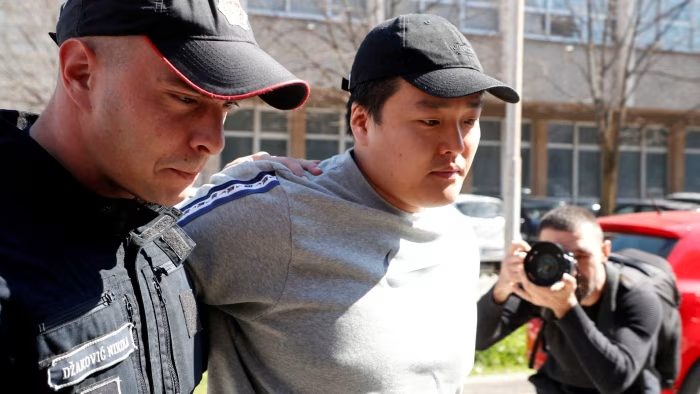
Kwon was arrested in Montenegro in March 2023 while traveling on a fake passport, leading to a lengthy extradition battle between U.S. and South Korean authorities. Kwon spent nearly two years in detention in Montenegro before being extradited to the United States in January, making his case one of the most interesting legal battles in the history of the crypto industry.
The article Do Kwon sentencing: US demands his 12-year imprisonment in connection with Terra collapse that wiped out $40 billion appeared first on Cryptonews Arabic.

