


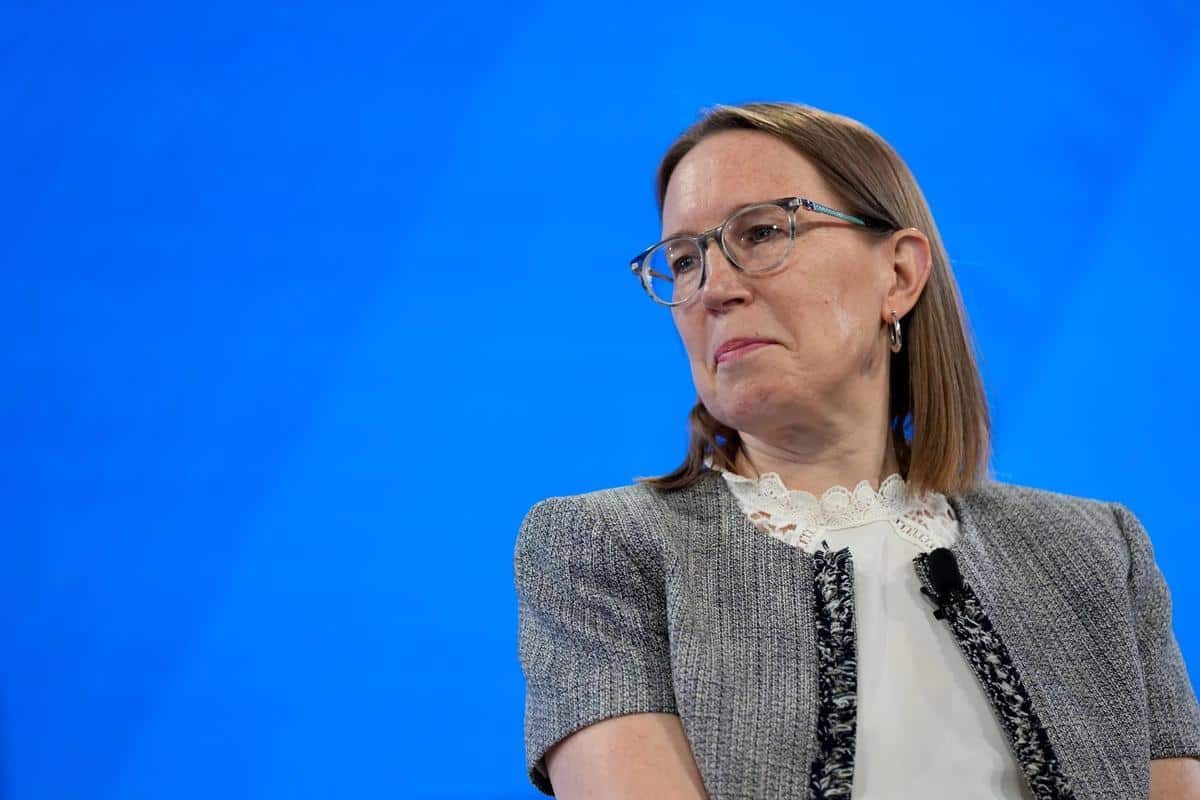
The most pro-innovation and crypto voice at the U.S. Securities and Exchange Commission (SEC) is preparing to depart, leaving behind an unfinished regulatory agenda for longer than most observers are willing to admit. Rules for stablecoins are not yet written, asset tokenization frameworks are still at the roundtable stage, and registration requirements for digital asset trading platforms lack a clear legal reference.
The Commission will have to resolve all of these thorny questions without the commissioner, who spent eight years insisting that these questions deserved regulatory answers rather than court subpoenas.
Regent University Law School announced that Hester Pierce, known in industry circles as “Crypto Mom,” will join it as an associate professor in November 2026, concluding a career at the SEC that began in January 2018. The Virginia-based school announced the appointment May 19, along with that of Gregory F. Jacob, a former Department of Labor attorney.
Pierce publicly indicated in March 2025 that she would not seek another term after her second five-year term expired in June 2025 and has served in an interim role since then. His November start date at Regent University fits this release plan perfectly.
Pierce’s regulatory record: Eight years of opposition that shaped the SEC’s position
It is necessary to fully understand the mechanism followed by the Authority; Under the leadership of Gary Gensler, the SEC has not issued rules governing token offerings, decentralized finance (DeFi) protocols, or the registration of crypto exchanges. Instead, he pursued a policy of coercive action, a model that Pearce has explicitly described as “regulation by coercion” and criticized in opposition notes dating back to 2020.
Pearce’s objection was structural rather than political, as she argued that coercive measures produced legal consequences limited to specific cases and did not provide permanent industry-wide guidance enabling widespread compliance.
Pearce has opposed several high-profile enforcement cases in the crypto space, including the 2021 DeFi Money Market Regulation, saying some of the targeted projects “were not scams but failed experiments” and that the Commission’s approach “imposes excessive costs and creates uncertainty.” It also adopted a “safe harbor” proposal for tokens, which gives development teams up to 3 years to achieve network decentralization before implementing securities registration requirements. This is a proposal that the Commission never officially adopted, but market lawyers used it as a framework to structure the launch of the tokens.
His history of opposition to Spot Bitcoin ETFs remains his most influential legacy. For years, Pierce has publicly criticized the SEC’s repeated denials, calling the agency’s position a “paternalistic and lazy approach to innovation.” She attributes the 2024 approvals, which she called “long overdue,” in part to legal and political pressure created by her persistent opposition. This is the practical effect of having an in-house dissident with a documented record, in that the dissidents’ memoranda become a road map for outside counsel and, eventually, the courts to follow.
Most recently, Pierce led the SEC’s Crypto Working Group, launched in January 2025. This team held public roundtables, rescinded previous guidance on banks’ custody of assets, and added industry members to advise on tokenization frameworks and exchange rules. This working group represents the institutional structure she built during her last term and will now have to function without her.
The article Hester Pierce’s departure from the SEC…the end of the ‘Crypto Mom’ era appeared first on Cryptonews Arabic.

