



It appears that the current Bitcoin market cycle could represent one of the most mature cycles yet, as new data from Glassnode shows an increase in institutional participation, a calm in trading conditions, and rapid growth in digitally represented real assets.
According to the Q4 digital assets report released by Glassnode and Fasanara Capital, the market structure has seen a notable change with the increased presence of large investors. For its part, the report estimates that Bitcoin attracted new investments amounting to approximately $732 billion during this cycle, in light of a sharp decline in volatility.
Additionally, realized year-over-year volatility has almost halved, indicating an increasingly larger and more stable market as institutional players play a larger role.
Bitcoin blockchain settlements reach $6.9 trillion, rivaling Visa and Mastercard networks
Settlement volumes remain a key indicator of market size, with Glassnode data indicating that the Bitcoin blockchain has settled approximately $6.9 trillion in transactions over the past 90 days, putting it on par with or above payments giants Visa and MasterCard.
Even as more activity moves off blockchain and into exchange-traded funds (ETFs) and brokerage channels, Bitcoin and stablecoins continue to dominate the transfer of value on public ledgers.
Investments in exchange-traded funds (ETFs) have reshaped the way capital flows into and out of assets, as the shift to regulated products attracts large trading volumes through traditional market channels, which has stabilized liquidity conditions and reduced the frequency of high volatility in spot trading.
Digitally represented funds gain traction as asset managers seek new distribution models
At the same time, digital representation has become one of the fastest growing areas in the digital asset sector.
The value of digitally represented real-world assets (RWA) grew from $7 billion to $24 billion in just one year, marking the strongest phase of institutional adoption. Glassnode notes that digitally represented funds, in particular, are gaining traction as asset managers seek new distribution models and investors seek simplified access to traditional instruments.
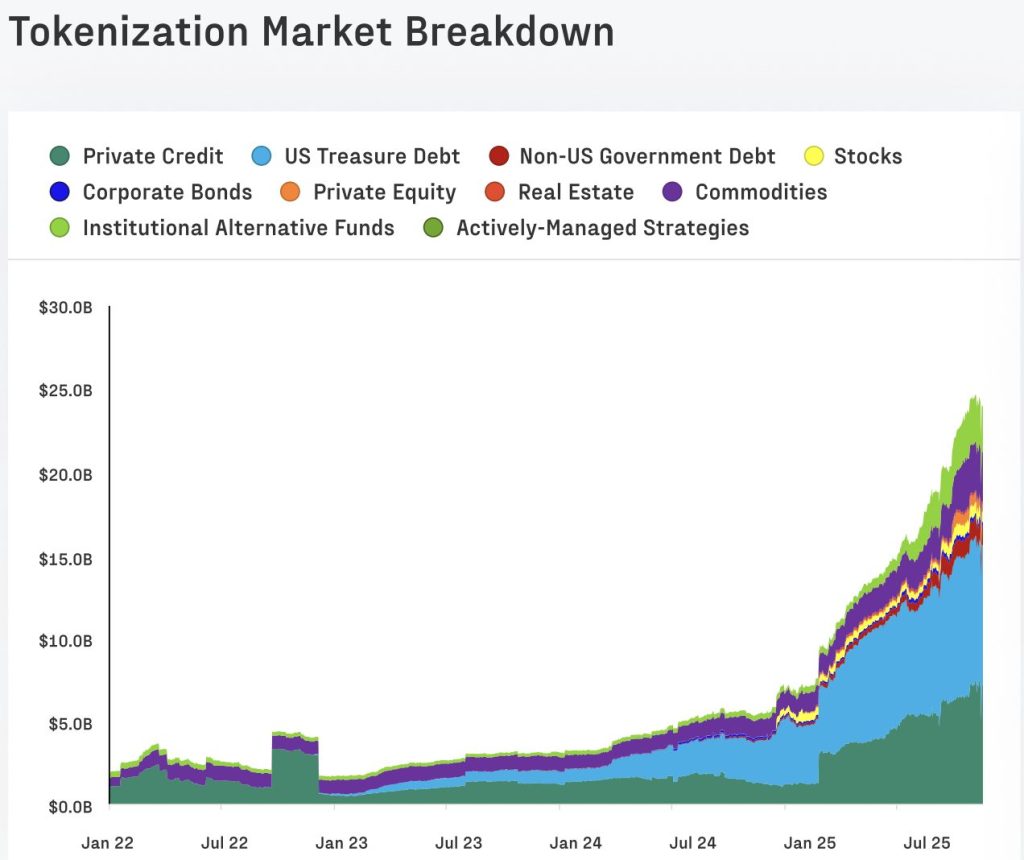
Source: Glassnode/Fasanara Digital
The expansion of digitally represented physical assets reflects broader interest from pension funds, hedge funds and corporations who want direct exposure to blockchain without betting on whether the price of major cryptocurrencies will rise or fall. This sector has seen continued investment through 2025, as platforms continue to improve their custody, compliance and settlement infrastructure.
Glassnode believes that the market has become more mature and characterized by its stability and large size.
Glassnode adds that as market structure has become larger and calmer, lower volatility, increased liquidity, and an increased share of institutional investment have reduced some of the extreme volatility that characterized previous cycles.
The company describes market trading as “quieter and larger with higher institutional participation,” a trend reflected by derivatives market, spot markets and blockchain data.
Although the atmosphere has become more stable now, activity has not diminished, as stablecoins still represent the main bridge between traditional and digital markets, and settlement demand continues to increase on both centralized trading platforms (CEX) and decentralized trading platforms (DEX). The report notes that this double structure now constitutes a feature of the technical system and no longer just a temporary bridge.
Real-world assets represented digitally accelerate market development and increase investor participation
Demand for exchange-traded funds (ETFs) has also encouraged more traditional market participants to engage in market making and arbitrage, helping to narrow spreads and reduce disruption during sell-offs. Glassnode reports that this feedback loop helps make the market more resilient compared to previous cycles.
As 2025 progresses, analysts expect institutional participation to deepen further, particularly with the increased adoption of digitally represented funds. As trust in regulated products increases and traditional assets become increasingly represented digitally on the blockchain, the gap between digital and traditional markets narrows.
The Glassnode report describes the current cycle as a turning point in market composition, as the combination of greater institutional investment, lower volatility, and a rapid increase in digitally represented physical assets indicates that a sector is entering a structurally more mature phase, even as macroeconomic conditions continue to influence risk appetite.
Post-institutional activity is increasing during the current Bitcoin (BTC) cycle, and the value of digitally represented real assets (RWA) reaches $24 billion according to Glassnode data appeared first on Cryptonews Arabic.

