


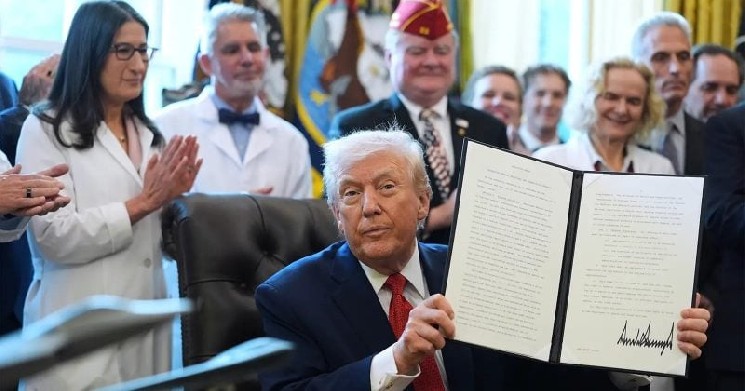
The Trump administration just did something no federal government has done before: put CBD on Medicare’s bill. A new pilot program will allow eligible seniors to access hemp-derived CBD products at no cost, marking the first time the U.S. government has subsidized cannabinoid products for its oldest and most medically dependent population.
The program, administered by the Centers for Medicare & Medicaid Services (CMS), is tied to an executive order that reclassifies marijuana as a Schedule III substance. This is the same category as Tylenol with codeine and anabolic steroids. In English: The federal government just moved cannabis from “no accepted medical use” to “yeah, doctors can probably work with that.”
How the program works
Eligible Medicare beneficiaries can receive hemp-derived CBD products for free, provided they have a doctor’s recommendation. The pilot covers approximately 34 million Medicare Advantage enrollees, representing a significant portion of the elderly population. If clinical results appear promising, the program could expand further.
The FDA has authorized some regulation to make this happen. The agency issued a notice stating that it will not enforce certain legal provisions regarding orally administered hemp-derived CBD products, provided those products meet specific criteria.
Market Reaction and Cannabis Stocks
Wall Street noticed. Public cannabis stocks surged after the announcement, reflecting strong market optimism about what federal adoption of CBD could mean for the entire industry.
The reclassification of marijuana to Schedule III opens the door for researchers to study cannabis compounds without ending up in the bureaucratic nightmare imposed by the Schedule I classification.
What this means for crypto and blockchain investors
Cannabis companies have historically had difficulty accessing banking services due to federal prohibition. This has pushed many operators towards crypto-adjacent payment solutions and blockchain-based supply chain tracking. A Schedule III reclassification could loosen traditional banking restrictions, which could paradoxically reduce some cannabis companies’ reliance on crypto rails.
There’s also the data angle. A pilot program covering millions of patients will generate enormous amounts of health outcomes data. Blockchain-based health data platforms could find new relevance if the government requires secure and transparent systems to track the effectiveness of CBD across a massive patient population.
The risk side of the equation is worth noting. Pilot programs can be stopped. A new administration could reverse the executive order. The FDA memo on enforcement discretion is just that, discretion, not a permanent rule change.

