


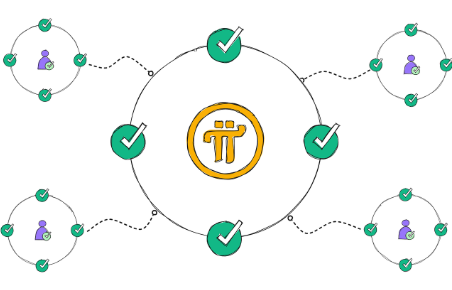
The convergence of Pi Network and OpenMind (OM1) is increasingly being interpreted as a defining signal of Pi Network’s long-term economic and technological vision. According to the analytical insights shared by @cryptoshun1980, this synergy represents more than a collaboration. It is presented as final proof that the Global Consensus Value, commonly known as GCV, is not a speculative construct but a mathematical necessity for the emerging era of artificial intelligence.
As AI-powered systems evolve, the economic frameworks that support them must adapt. The Pi Network’s alignment with OpenMind introduces a narrative that positions Pi not simply as a digital currency, but as a precision economic layer designed for machine-scale execution. In this context, the GCV is positioned as a fundamental parameter and not a market-driven target price.
At the heart of this argument is the precision of the 314.159 reference value. Often associated with mathematical constants, this figure is interpreted as a deliberate design choice rather than symbolism. In an economy increasingly described as an “Uber for robots,” machines are expected to execute millions, if not billions, of microtasks autonomously. Each task may have extremely small economic value, but together they form a massive transactional ecosystem.
A high Global Consensus Value allows for extreme divisibility. When Pi is divisible down to 0.00000001 units, it allows transactions to occur at close to zero cost while maintaining meaningful internal accounting. This level of granularity is essential for AI and robotic economies, where efficiency is measured in microseconds and fractions of value. Without that divisibility, transaction costs would quickly outweigh utility.
From a technical perspective, this design addresses one of the most persistent challenges in blockchain-based AI economies: scalability without economic distortion. Traditional low-value tokens struggle with precision at scale, while high-volatility assets introduce instability. Pi Network’s GCV framework aims to balance both, offering stability through consensus and flexibility through divisibility.
The synergy with OpenMind further reinforces this model. OpenMind’s focus on artificial intelligence and autonomous systems requires an economic layer that can operate continuously without human intervention. In such an environment, pricing mechanisms cannot depend on speculative market swings. They must be predictable, mathematically sound, and resistant to manipulation.
Another critical dimension of this synergy is privacy-preserving identity verification. With the integration of advanced Stellar protocols, including those called Protocol v25, Pi Network is positioned to leverage zero-knowledge proofs for human KYC validation. This allows machines to verify that an entity is human without accessing or storing private identity data.
This approach fundamentally changes the way identity is handled in AI-powered systems. Instead of exposing sensitive information, verification becomes a mathematical proof. Autonomous robots and agents can confirm eligibility, authenticity or access rights through cryptographic guarantees instead of centralized databases. This model preserves privacy while maintaining trust.
In practical terms, this means that an AI system operating within the Pi Network ecosystem could verify that it is interacting with a real human participant without even knowing who that human is. This separation of identity and verification is crucial in a future where machines economically interact with both humans and other machines.
The implications for Web3 are substantial. Many decentralized platforms struggle to reconcile privacy with compliance and trust. Zero-knowledge-based Human KYC offers a path where decentralization does not require anonymity at all costs, nor does verification require surveillance. Pi Network’s alignment with this philosophy positions it as a potential bridge between regulatory expectations and decentralized ideals.
The concept of GCV as a mathematical necessity gains even more weight in this context. For machines to transact autonomously for decades, the underlying economic unit must remain stable across technological cycles. Market-driven prices alone cannot guarantee this stability. Consensus-driven benchmarks, applied at the protocol level, offer a more durable solution.
This does not imply that external price determination is irrelevant. Rather, it suggests that the Pi Network is separating internal economic logic from external market behavior. Internally, AI systems and decentralized applications operate according to predictable rules. Externally, markets can assign variable valuations. This separation reduces systemic risk.
 |
| Source: Xpost |
Fundamentally, this article includes predictive and technical analysis and may differ from actual results. The practical implementation of extreme divisibility, zero-knowledge verification and AI-scale transactions will depend on implementation, adoption and regulatory developments. However, the conceptual coherence of this model is increasingly difficult to ignore.
Observers note that few blockchain projects are explicitly designed for machine economies. The majority remains focused on human-centered financial speculation. Pi Network’s apparent willingness to design native AI use cases suggests a longer time horizon. It involves preparation for an economy in which humans are not the main executors of transactions, but rather the main beneficiaries.
The reference to an “Uber for robots” economy is not rhetorical. Autonomous delivery systems, robotic manufacturing, and AI-driven services require settlement layers capable of handling massive transaction volumes with minimal cost. Pi Network’s GCV-based divisibility model directly addresses this requirement.
From a strategic standpoint, the integration of perceived privacy preservation through Stellar protocols adds another layer of future readiness. As AI systems gain perception capabilities, the ability to verify context and eligibility without violating privacy becomes essential. The Pi Network approach suggests understanding that trust in the age of AI must be cryptographic, not observational.
For developers, this model opens up new possibilities. Apps can be built assuming a stable microtransaction economy and strong identity guarantees. For users, it suggests participation in an ecosystem designed not only for today’s markets, but also for the autonomous systems of tomorrow.
It remains uncertain whether the GCV will eventually be widely accepted as a functional reference value. Adoption is not guaranteed and traditional market participants are likely to resist. However, the argument that GCV is a mathematical necessity rather than a speculative aspiration reframes the debate entirely.
If the Pi Network and OpenMind manage to put this synergy into practice, it may represent one of the first examples of a blockchain economy intentionally designed for AI-scale execution. In that case, GCV would not be remembered as a number, but as an architectural choice.
As Web3 continues to intersect with artificial intelligence, projects that anticipate the native machine economy may gain a structural advantage. Pi Network’s alignment with OpenMind suggests it is positioning itself for that intersection.
In the broader narrative of cryptocurrency evolution, this moment may mark a transition from human-centric speculation to machine-friendly infrastructure. If that transition defines the next era, then the Pi Network’s emphasis on mathematical precision, privacy-preserving verification, and consensus-driven value could prove less controversial than inevitable.
In that sense, the synergy between Pi Network and OpenMind not only supports the idea of GCV. It reformulates it as an engineering requirement for a future where economic activity is continuous, autonomous and deeply integrated with artificial intelligence.
hokanews – not just cryptocurrency news. It’s cryptoculture.
Writer @Victory
Victoria Haleis a pioneering force in the Pi Network and a passionate blockchain enthusiast. With first-hand experience setting up and understanding the Pi ecosystem, Victoria has a unique talent for breaking down complex developments in the Pi Network into engaging, easy-to-understand stories. It highlights the latest innovations, growth strategies, and emerging opportunities within the Pi community, bringing readers closer to the heart of the evolution of the crypto revolution. From new features to analysis of user trends, Victoria ensures that each story is not only informative but also inspiring for Pi Network enthusiasts everywhere.
Disclaimer:
HOKANEWS articles are here to keep you up to date on the latest rumors in crypto, technology, and more, but they are not financial advice. We share information, trends and knowledge, we don’t tell you to buy, sell or invest. Always do your own homework before making any money moves.
HOKANEWS is not responsible for any loss, gain or chaos that may occur if you act on what you read here. Investment decisions should arise from your own research and, ideally, the guidance of a qualified financial advisor. Remember: cryptocurrencies and technology move fast, information changes in the blink of an eye, and while we strive for accuracy, we cannot promise that it is 100% complete or up-to-date.

