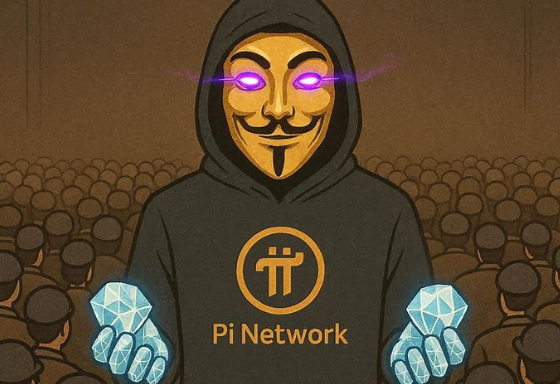
Pi Network sparks debate after viral job suggestion message
A recent statement circulating within the crypto community has sparked widespread debate about work culture, financial independence, and the role of blockchain ecosystems in shaping future revenue models. The message, shared on social platforms, suggested that people dissatisfied with their current jobs should consider focusing on the Pi Network, a decentralized digital ecosystem still in development.
The statement quickly attracted attention because it touches on a sensitive and increasingly relevant topic: the relationship between traditional employment and emerging digital economies. As Web3 technologies continue to evolve, questions about how people earn income, provide value, and participate in digital systems become more prominent.
In the traditional economic model, employment is usually linked to structured organizations, fixed salaries, and clearly defined job roles. People trade time and skills for financial compensation within centralized systems. However, the rise of blockchain-based platforms has introduced alternative models where network participation, contribution and engagement can play a role in creating value.
The Pi Network is often discussed in the context of these new economic structures. The project has built a large global user base and emphasizes accessibility through mobile engagement. This approach reduces barriers to entry and allows people from different regions to interact with the ecosystem without the need for specialized hardware or technical expertise.
The viral message suggesting that people quit their jobs to focus on the Pi Network has generated mixed reactions. Some see it as an expression of a strong belief in the potential of decentralized systems, while others see it as an unrealistic interpretation of blockchain development in its early stages.
In the broader context of Web3, the idea of completely replacing traditional work with decentralized participation remains largely theoretical. While blockchain systems can create new forms of digital interaction and value exchange, they are not yet widely recognized as full substitutes for established employment structures.
One of the key distinctions in this discussion is between participation and guaranteed income. Many blockchain ecosystems allow users to engage in activities that can contribute to future value creation, but typically do not provide stable or predictable income comparable to traditional jobs.
Pi Network, like many early-stage blockchain projects, is still focused on building its infrastructure and expanding its ecosystem. This includes developing applications, increasing user engagement, and exploring potential use cases for your digital environment. However, the entire economic model of the ecosystem is still evolving.
The suggestion that people could leave their jobs to focus entirely on such a system raises important questions about financial risk and sustainability. In any emerging technology sector, especially one as volatile as cryptocurrencies, long-term outcomes are uncertain and largely dependent on successful execution and adoption.
At the same time, the statement reflects a broader sentiment within parts of the crypto community: the belief that decentralized systems could eventually transform the way people work and earn income. This belief is rooted in the idea that blockchain technology can enable peer-to-peer exchange of value without traditional intermediaries.
In theory, Web3 ecosystems aim to create environments where users are not just consumers but active participants in value creation. This includes contributing to networks, creating applications, validating transactions, and participating in decentralized governance systems.
However, the transition from theory to practice is complex. Most blockchain projects are still in the early stages of development and require a lot of time to achieve widespread adoption and functional maturity. During this period, expectations about income and participation must be carefully balanced with practical realities.
Pi Network’s development strategy has emphasized gradual ecosystem growth rather than immediate financial integration. This approach focuses on building a strong user base first, followed by introducing more advanced features and apps over time.
In this context, statements encouraging full dependence on the platform to earn a living can be considered premature. While enthusiasm and faith in innovation are common in emerging technologies, sustainable economic decisions often require stable and verifiable systems.
The debate also highlights a broader tension within the crypto industry: the gap between vision and execution. Many projects present ambitious ideas about transforming finance, work and digital interaction, but the realization of these visions depends on technical development, adoption rates and regulatory environments.
 |
| Source: Xpost |
Work itself is undergoing a transformation due to digital technologies. Remote work, sharing economies, and platform-based services have already changed the way people earn income in many parts of the world. Web3 technologies represent a further evolution of this trend, but are still in the early stages of integration into conventional economic systems.
Specifically for the Pi Network, the focus remains on ecosystem development and user engagement. Whether it evolves into a platform capable of supporting full-time economic activity will depend on future infrastructure, application development and real-world utility.
The viral nature of the statement also reflects how quickly narratives can spread in digital communities, especially in the crypto space. Social media plays an important role in shaping perception, often amplifying optimistic or speculative views.
This makes it important for users to differentiate between community sentiment and verified functionality. In emerging technologies, enthusiasm can sometimes exceed the actual capabilities of the system, leading to misaligned expectations.
In conclusion, the recent discussion around the Pi Network and the idea of abandoning traditional employment highlights both the excitement and uncertainty that characterize the Web3 landscape. While decentralized systems offer new possibilities for participation and value creation, they are still evolving and have not yet replaced traditional economic structures.
The Pi Network remains part of this broader experimental phase in blockchain development. Its long-term role in the digital economy will depend on how effectively it moves from community-driven engagement to fully functional real-world utility.