


Log into Coinbase next tax season and your tax documents may no longer arrive in the mail.
Under a new IRS proposal, crypto exchanges may be required to file Form 1099-DA electronically. This form reports digital asset transactions and can refuse to do business with customers who refuse to provide it.
The comment period ends on May 5 and if finalized, the rule would move crypto tax reporting from the mailbox to the platform.
This is not a tax cut or a rollback of reporting requirements. Brokers always send identical information to the IRS, regardless of how they deliver forms to clients. The proposal allows exchanges to mandate app-based delivery.
The result: millions of cryptocurrency users would receive their tax forms exclusively by email and in-app document centers, without paper backup or the right to revert.
The problem: taxes on cryptocurrencies are not getting lighter. They become quieter.
What really changes
The IRS proposal creates an alternative electronic delivery process for Form 1099-DA.
Under current rules, brokers must offer their clients paper forms. The proposal would allow exchanges to use simplified consent, in which customers agree to electronic delivery during account setup, and exchanges could terminate relationships with anyone who refuses.
Consent would likely appear as a pop-up with an “I agree” button, with text stating that the broker cannot continue serving customers who refuse.
Once customers consent, exchanges would not be required to let them withdraw that consent while still remaining customers. The only guaranteed paper solution would be an email delivery failure notice, not the full tax document.
Delivery would be through submission of forms to an online document center with email notification or via direct email attachment.
Exchanges must maintain access until October 15 of the following year and retain prior reporting for seven years. An undeliverable email triggers a physical notification within 30 days, but it is procedural and does not replace the email message many users expect.
Biggest app change
This proposal is part of a broader compliance framework.
Beginning on or after January 1, 2025, crypto brokers must file Form 1099-DA reporting gross proceeds.
Baseline reporting, the cost information needed to calculate gains and losses, will be phased in for certain transactions starting January 1, 2026, only for covered assets acquired and held from the same broker.
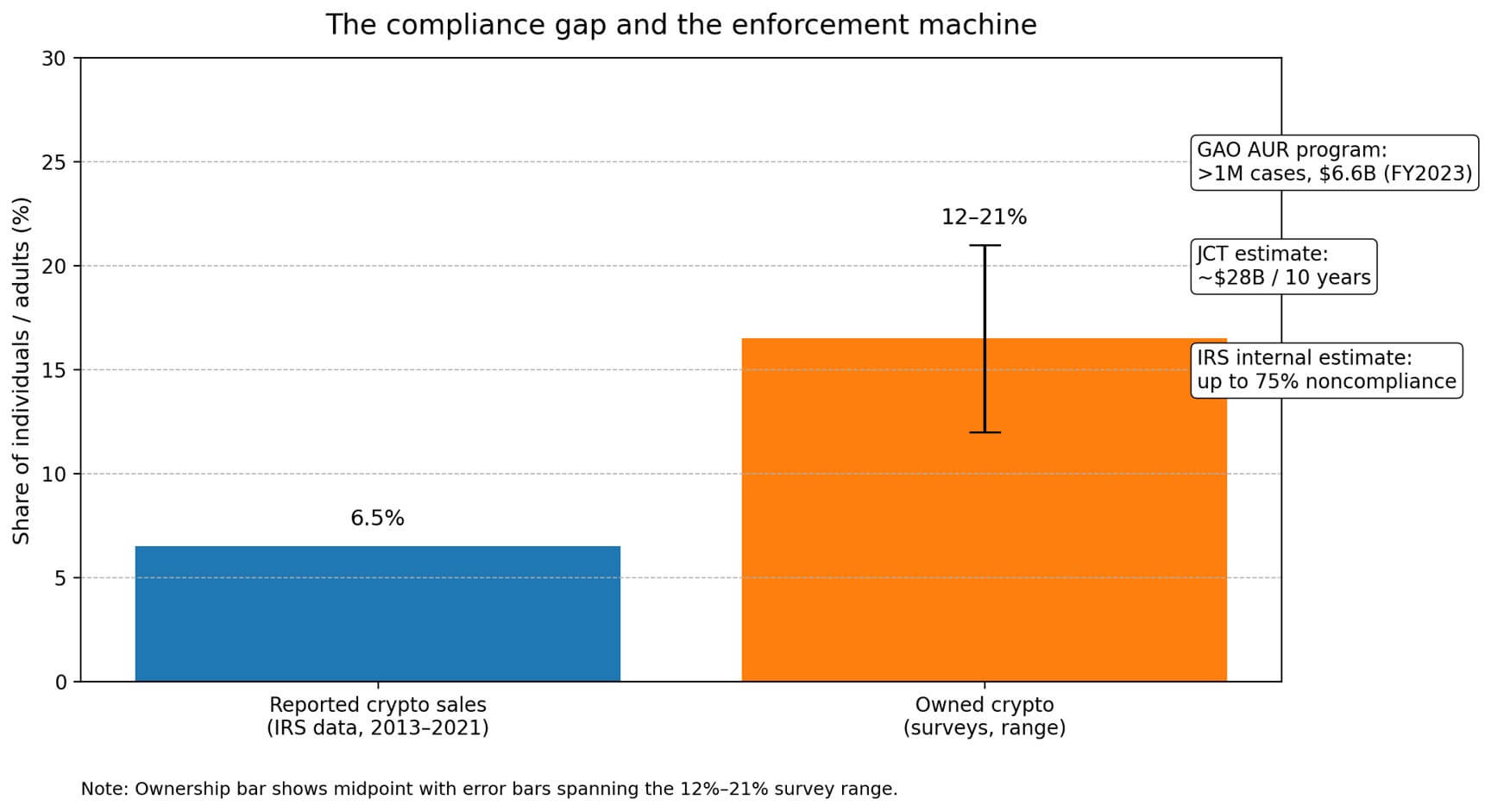
Application calculations are important. A report from the Government Accountability Office found that the IRS Automated Underreporter program identified potential underreported income in more than 1 million cases, totaling $6.6 billion, in fiscal year 2023.
Form 1099-DA flow corresponding to the matching engine. An IRS research paper found that 6.5% of individuals, or 17.4 million people, reported selling cryptocurrencies between 2013 and 2021, while external surveys suggest that 12% to 21% of U.S. adults owned cryptocurrencies.
This discrepancy means that many holders never appear in sales reports.
The Joint Committee on Taxation estimated that digital asset reporting provisions would raise about $28 billion over 10 years. The IRS cites an internal study estimating that up to 75% of taxpayers with digital assets are non-compliant.
The electronic delivery proposal is not intended to ease burdens. This is about standardizing the infrastructure for automated compliance.
What Retail Users Would Notice
The user experience is moving from annual paper envelopes to persistent digital workflows. Tax season becomes a document center notification rather than a mailbox event.
For users accustomed to physical forms as a filing reminder, this change creates new ways to miss deadlines.
The exchanges would integrate consent into onboarding or account settings, presented as common platform terms. Email delivery is dependent on users keeping current contact information and checking spam filters.
In-app document centers mix tax forms into notification feeds that handle business confirmations, security alerts, and promotions. The seven-year retention requirement means that historical forms remain accessible, but only if users know to search for them.
Coinbase’s 10-K 2025 reports 9.2 million monthly transacting users and $376 billion in assets on the platform. Other major exchanges have a comparable scale.
If even a fraction of tax documents adopt mandatory electronic consent, the volume of tax documents circulating exclusively through digital channels becomes substantial.
Daily signals, zero noise.
Headlines and context that evolve in the market, delivered each morning in a single careful reading.
5 minute summary 100,000+ readers
Free. No spam. Unsubscribe at any time.
Oops, looks like there was a problem. Please try again.
You are subscribed. Welcome aboard.
The app becomes more invisible
The key distinction: This proposal changes how customers receive forms, not whether the IRS receives them.
The brokers’ reports to the government remain unchanged. An exchange that switches to application-only delivery still files identical information with the IRS.
The IRS explicitly states that taxpayers must report digital asset transactions whether or not they receive Form 1099-DA. The agency emphasizes recordkeeping: Taxpayers must keep their own basic records to calculate gains and losses, especially during the introduction phase, when many forms will not include a basis.
For 2025 transactions, brokers generally only report gross proceeds. Baseline reporting begins in 2026 for certain assets held with the same broker at acquisition.
This creates a compliance gap where users require their own trade history exports even if they receive a form. The electronic delivery proposition makes access to historical data more dependent on platform tools, such as document centers, CSV exports and API access, rather than mailed statements.
From a law enforcement perspective, the change is effective. Returns are submitted to the IRS digitally, regardless of the customer’s delivery method. Automated matching compares deposits to broker reports without manual intervention.
Users who miss app-based notifications still face notifications, penalties, and potential interests. The system becomes less visible to inattentive users while remaining fully visible to the IRS.
What happens next
The proposal is open for public comment until May 5, 2026. If finalized, it would apply to forms filed on or after January 1 of the calendar year following publication, meaning the first effect would be the 2027 tax season or later.
Whether exchanges adopt mandatory electronic delivery is a business decision. The proposal creates an authorization, not a mandate. Some brokers retain paper options as customer service, while others find digital-only to be operationally simpler.
Adoption rates will determine how many users face the choice of “opt in or lose access.”
Users should assume that electronic delivery will become the norm on major platforms once permitted.
Think of Exchange email settings as a tax on critical infrastructure. Make sure contact information remains up to date. Enable document notifications. Check spam filters before February 15, when forms are due. Download and save trade history regularly, especially for cross-platform trades where no broker has complete background information.
The broader context is that of global convergence towards standardized tax reporting on cryptocurrencies.
The OECD crypto-asset reporting framework is being adopted in all jurisdictions. The EU’s DAC8 directive extends reporting to crypto assets. The American electronic delivery proposal is part of a multi-year development process during which the informality premium of cryptography diminishes in favor of the feedback of traditional securities.
Cryptocurrency tax reporting does not disappear in applications to ease compliance. It evolves within the digital rails to make the application more automatic and harder to ignore.
The IRS does not delete paper trails. It moves from the mailbox to the platform, where broker copies continue to arrive at the government, while client copies become just another notification in a cluttered interface.

