


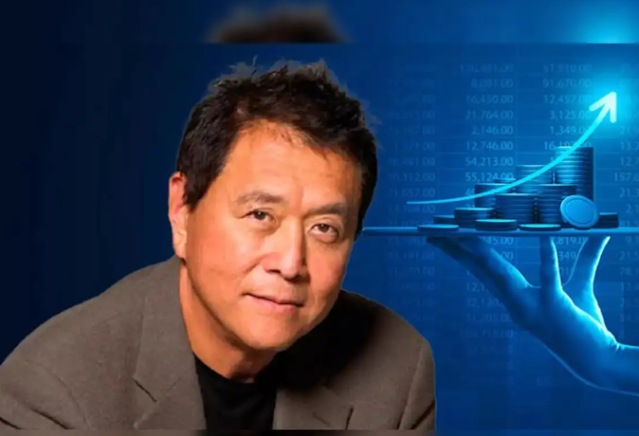
Robert Kiyosaki warns of ETF: why prefers physical gold and bitcoin about “paper assets”
Renowned investor and author of the best -selling financial guide Poor dad dad dadRobert Kiyosaki, once again he is raising his eyebrows in the world of investments, this time when challenging the reliability of the funds quoted in exchange (ETF) when it comes to storing asset value such as gold, silver and bitcoin.
While ETFs have fired in popularity in recent years due to their accessibility and ease of commerce, Kiyosaki warns that these financial products may not offer the security that many believe they have, especially in times of financial crisis.
“Sometimes it is better to have real gold, silver, bitcoin and a weapon,” Kiyosaki said in a recent statement, emphasizing the importance of self -sufficiency during economic instability.
The problem with the ETF, according to Kiyosaki
Kiyosaki argues that while ETFs can simplify the investment process for the average person, they mainly represent paper property instead of Physical control. In a financial collapse scenario, of the type that often warns readers who prepare, believe that paper statements could be useless if institutions support them fail.
“Having an image of a gun can be comforting in good times,” he added, “but will not help in a real emergency. The same logic applies to paper assets that claim to represent a real value.”
The Finance Guru has long advised investors who accumulate tangible assets, such as gold and physical silver, or decentralized cryptocurrencies such as Bitcoin, which can be maintained independently without depending on centralized institutions.
Kiyosaki’s concern lies in the possibility that ETFs, regardless of how well regulated, can face systemic liquidity problems or redemption in a financial collapse. If the custodians who maintain the real assets failed, he says, ETF’s actions could become practically useless.
Why Kiyosaki believe in real assets
The core of Kiyosaki’s philosophy is financial sovereignty. He maintains that real wealth comes not only from the value of the assets maintained, but from the control of the investor on them.
Unlike fiduciary currencies, which it refers as “false money”, gold, silver and bitcoin are finite and non -manipulable assets. They are not subject to inflationary pressures of the policies of the Central Bank, making them, in their opinion, more reliable in the long term.
 |
| Source: x |
“The US dollar is designed to lose value,” he said. “Fiduciary money has always failed. History is full of examples.”
This distrust in fiduciary currencies is precisely why gold and physical silver see as timeless value stores. And in the digital era, Ver Bitcoin, when self -diary, as a form of “digital gold” that provides similar protection without the load of physical storage.
ETF markets are still booming
Despite the vocal skepticism of Kiyosaki, ETFs continue to attract record capital levels.
On Friday, the ETF of Bitcoin Spot of the USA.
Among the best artists were:
-
Blackrock’s Ishares Bitcoin Trust (ibit): $ 92.83 million
-
Hodl ETF of Vaneck: $ 18.16 million
-
FBTC of Fidelity: $ 10.19 million
Etfs Ethereum also enjoyed a strong day, with more $ 452 million In entries on the same date, a sign that the appetite of investors by the financial instruments backed by cryptography remains solid despite the continuous regulatory uncertainty in the United States
This growing demand illustrates a fundamental contradiction in the investment panorama: while traditional financial advisors and retail investors are investing money in ETF for their convenience, high -profile critics such as Kiyosaki warn that such ease has a cost.
ETF analysts shoot back
Industry experts have challenged Kiyosaki’s claims, calling them exaggerated and out of contact with how ETF really works.
Eric Balchunas, an ETF senior analyst in Bloomberg, said that ETFs, especially those that deal with basic and cryptographic products, are individually backed by underlying assets and are retained with custodians regulated under strict legal marks.
“ETFs are one of the most transparent and safe investment vehicles available today,” said Balchunas. “They offer exposure to real assets, without personal storage complexities, especially for those who cannot pay or administer cold wallets.”
Balchunas also pointed out that physical gold can be stolen, silver can tarnish and cryptocurrencies kept out of exchanges are vulnerable to user error or hardware failure.
“The idea that the physicist is always safer does not remain in all scenarios,” he added.
Convenience vs. control
This debate between paper and physical assets reflects a broader ideological division in financial strategy, one that touches trust tolerance and individual autonomy.
On the one hand, ETFs offer liquidity, regulated supervision and ease of access, especially attractive to retail investors entering cryptography or basic products for the first time. On the other hand, physical and decentralized assets offer unique control and reduce exposure to institutional insufficiency.
Kiyosaki does not completely rule out ETFs. In fact, he recommends them as a point of entry for beginners. But urges investors to understand their limitations.
“Know the difference between when it is better to maintain paper, and when it is necessary to own the real,” he advised.
This nuanced position reflects its broader vision: use the available tools, but do not become a system dependent, especially one that believes that it is manipulated against the average person.
A growing debate in a changing market
It is unlikely that the clash of perspectives is faded soon, especially as more companies jump to the ETF market. Former President Donald Trump supported Truth Social recently requested an ETF list, joining a growing list of companies that seek to capitalize on the boom in titled versions of digital and physical assets.
As the ETFs become more sophisticated and regulators harden supervision, the distinction between “paper” and “real” can become more blurred. But for Robert Kiyosaki, the message is still clear: true wealth lies not only in what he possesses, but in how much control he has about him.
Writer
@Ellena
Ellena is an experienced cryptographic writer who loves to explore the intersection of blockchain technology and financial markets. She regularly provides information about the latest trends and innovations in the currency space.
See other news and articles on Google News
Discharge of responsibility:
The articles published in Hokanews are intended to provide updated information on various topics, including cryptocurrency and technology news. The content on our site is not intended to be an invitation to buy, sell or invest in any asset. We encourage readers to conduct their own research and evaluation before making an investment or financial decision.
Hokanews is not responsible for any loss or damage that may arise from the use of the information provided on this site. Investment decisions must be based on an exhaustive investigation and advice of qualified financial advisors. Information about Hokanews can change without prior notice, and we do not guarantee the precision or integrity of the published content.

