


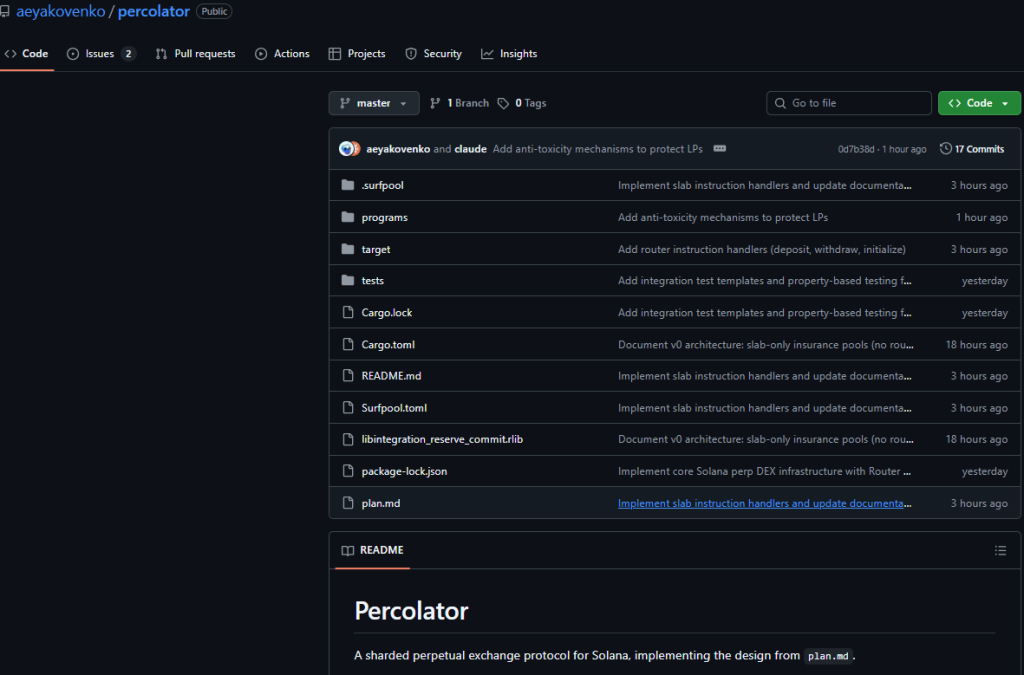
Anatoly Yakovenko, co-founder and CEO of the Solana Coin Project, has unveiled a new decentralized futures trading protocol called “Percolator”, designed to operate primarily on the Solana blockchain.
The project repository was published on GitHub on October 19, detailing what Yakovenko described as a ready-made technical plan to develop a decentralized perpetual futures trading platform with a sharded architecture capable of competing with major legacy platforms like Aster and Hyperliquid.
The launch of the Percolator project comes at an important time for the Solana technology ecosystem. Although the decentralized finance (DeFi) sector within the Solana Blockchain is constantly growing, the perpetual futures trading market continues to lag behind its competitors, notably the Hyperliquide platform, which has acquired a significant percentage of it in recent months.
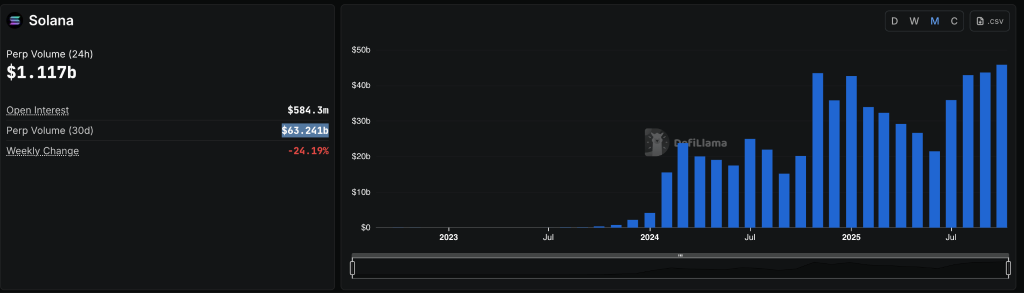
The data indicates that the trading volume on decentralized perpetual contract platforms built on the Solana blockchain decreased by 24.19% compared to the previous week, bringing the total monthly volume to approximately $63.24 billion, indicating a gradual decline in market dynamics and trading volumes.
Yakovenko’s move appears aimed at establishing a new layer of infrastructure capable of attracting liquidity providers and fast traders who are looking for decentralized alternatives to central trading platforms.
Percolator project could revive DeFi activity on Solana blockchain as meme coin wave subsides
The Percolator Protocol seeks to offer a dual software architecture combining high performance and flexibility with routing software that manages collateral, portfolio margining and routing between trading tiers, as well as independent modules called “Slabs” which act as independent trading engines operated by the liquidity providers themselves.
According to the documents, the Percolator project aims to achieve execution speed similar to that of centralized trading platforms, by adopting multi-slice order books that allow different trading pairs or markets to operate simultaneously without competing for computing power. Yakovenko says this approach can avoid network congestion during periods of high trading volume, a recurring problem faced by many decentralized trading platforms.
“The design keeps each liquidity unit completely independent and scalable, the overall efficiency of the fund is comparable to single decentralized trading platforms and often achieves better quality of execution through selective routing,” Anatoly Yakovenko wrote in his technical summary.
Although the software base of the project is still under development and some processes such as account verification and updating funding rates remain to be finalized, many data infrastructures have already been completed. The project’s GitHub files indicate that the system is approaching the stress testing phase, in a potentially important step to boost the DeFi sector on the Solana Blockchain.
The timing of the announcement is particularly significant as the Solana blockchain has recently lost some of its strength in the meme market, which was previously the focus of user activity, while interest from small investors has declined sharply after the broad wave of correction seen in digital currency markets in October.
According to a report by Cryptonews, more than $28 billion in meme coin market capitalization was liquidated in mid-October, dropping from $72 billion to $44 billion, erasing gains accumulated over the months due to high trading activity on the Solana blockchain and BNB chain.
 The coin market crash wiped out $28 billion in value, bringing the total capitalization down to $44 billion.
 This decline has left Solana in need of new growth engines to support future expansion, and the pace of activity on launch platforms on the Solana Blockchain has slowed, with weekly trading volumes falling from $1.5 billion in July to nearly $600 million by the end of September.
In this context, the Percolator project constitutes a potential strategic shift, as it seeks to reaffirm the technical superiority of the Solana blockchain in the DeFi sector by entering the highly competitive domain of perpetual futures trading.
The Solana project is also working to significantly increase its network performance, as the blockchain network recently recorded 623 consecutive days without any interruption, which is the longest period of continuous operation since its launch in 2020, reflecting clear progress in its stability and technical maturity.
BREAK: @Solana reached 623 days without an outage, its longest streak since its launch in 2020. The previous record was 347 days, and upgrades after 2024 have strengthened network stability, with Solana remaining fully operational during major market events like the Trump… pic.twitter.com/AyXr5QdRf7
– SolanaFloor (@SolanaFloor) October 20, 2025
This improved technical stability could boost developer and merchant confidence as the Solana blockchain seeks to regain its place within the DeFi ecosystem, which could serve as a strategic advantage for Percolator in the future.
Trading volume on perpetual futures platforms exceeds $1.15 trillion as decentralized blockchain trading platform Solana enters the competition.
Decentralized perpetual contract trading platforms appear to be one of the most important business sectors in the field of decentralized finance, as these platforms allow users to speculate on the prices of digital currencies without contract expiration dates, with direct settlement on the network and continuous access to markets 24 hours a day.
According to DeFiLlama data, the total trading volume over the past 30 days in this sector has exceeded $1.15 trillion, indicating a rapid transition from centralized trading platforms to decentralized derivatives contracts platforms.
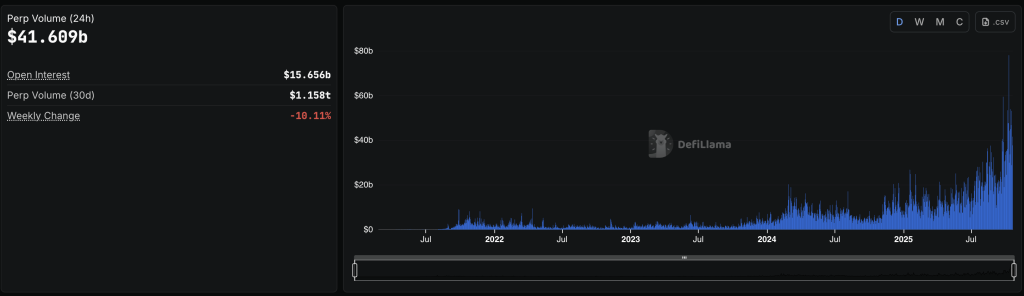
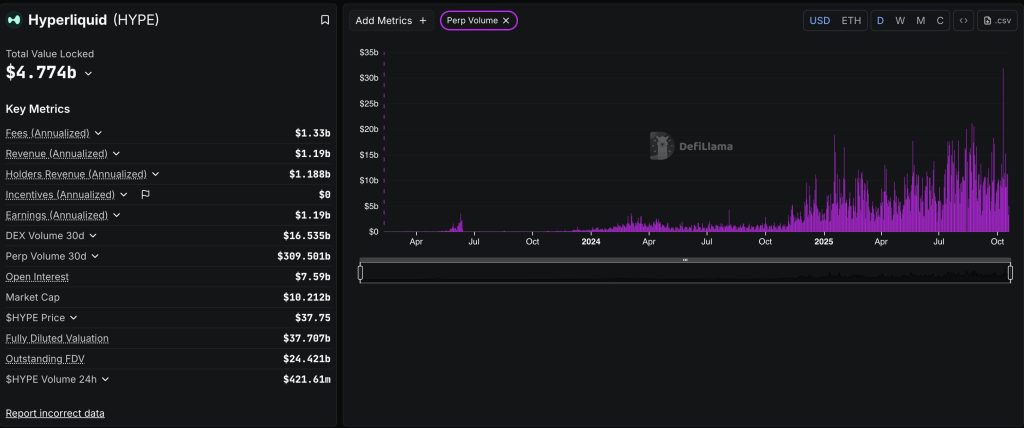
Hyperliquid and Aster currently dominate the decentralized perpetual futures trading sector, and Hyperliquid runs on its own layer-one blockchain and has the highest liquidity levels with $7.59 billion in open contracts and $309 billion in trading volume over the last 30 days.
The platform has become a benchmark for speed of execution and quality of transactions, with daily trading volumes reaching $17 billion at its peak this year, with the market value of its digital currency Hyperliquid-HYPE standing at approximately $10.2 billion, supported by annual revenues of approximately $1.19 billion.
The Aster platform is a strong and active competitor in the sector, as it is built on the Binance blockchain (BNB Chain) and at the same time, it has emerged and enjoys the support associated with the co-founder of the Binance platform Chengpeng Zhao (CZ), and the platform has managed to benefit from his support of several blockchain networks and extensive incentive programs to increase its base. users very quickly.
According to recent data, Aster recorded annual revenue of $2.97 billion, more than double the revenue of Hyperliquide, as well as a trading volume of $145 billion over the last 30 days in the perpetual contract market. It also temporarily overtook Hyperliquid in daily trading volume earlier this month.
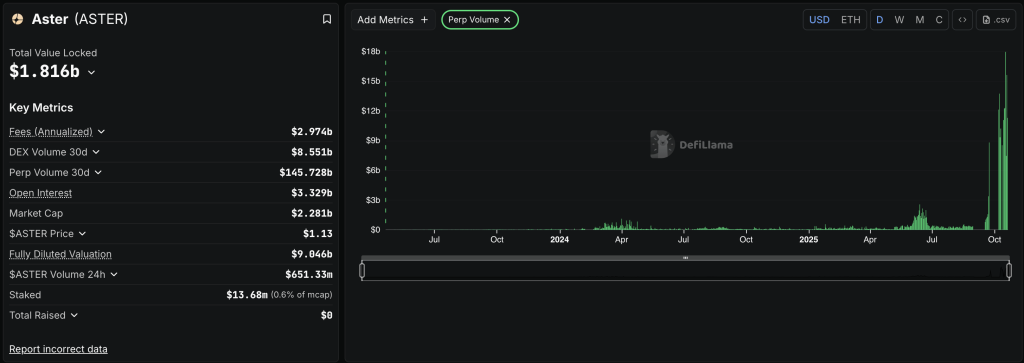
Today, Aster and Hyperliquid are at the forefront of the decentralized derivatives trading scene, but the design of the Percolator project could introduce a new element into the equation. Leveraging the high-throughput, low-cost Solana Blockchain architecture, the project seeks to deliver the efficiency of Hyperliquid combined with the modular flexibility of Aster, but in a fully native Solana environment, directly on the network.
Yakovenko’s decision to make the design available as open source code demonstrates a clear commitment to the principle of transparency and the spirit of community cooperation, and the project’s technical documentation includes risk control mechanisms such as Capability-Scoped Escrow and Atomic Routing, which are designed to prevent excessive discounts from suppliers. Multiple liquidity in a single transaction.
The move also comes at a time when user movements are moving between different blockchain networks. A July VanEck report noted that Hyperliquid was attracting users with large wallets of the Solana blockchain, as traders sought simpler and faster options for trading perpetual contracts.
If successful, Percolator could help reverse this trend and bring professional traders back to the Solana technical system. However, competition remains intense, as Aster and Hyperliquid still have large liquidity pools and extensive institutional support.
The post Solana-SOL coin project founder reveals decentralized Percolator platform for futures trading, in direct challenge to Aster and Hyperliquide platforms appeared first on Cryptonews Arabic.

