


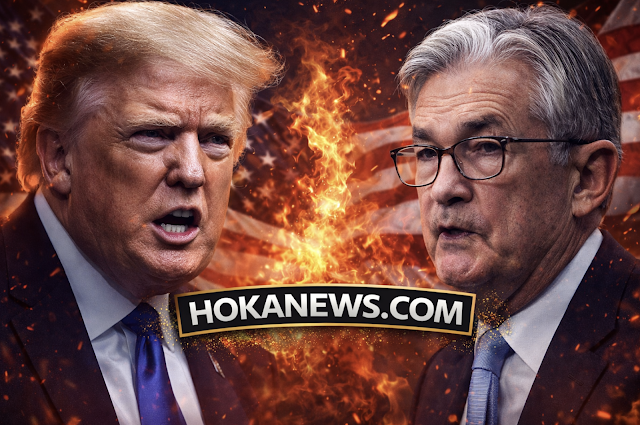
Trump calls Federal Reserve Chairman Jerome Powell a “fool,” reigniting tensions over US monetary policy.
A new point of political tension has emerged in Washington after donald trump publicly criticized Jerome Powellcalling the chairman of the Federal Reserve a “fool” in comments that quickly reverberated through financial markets and political circles.
The comment, which first circulated on social media and was later picked up by major market watch accounts, was confirmed by a report cited by VigilanteGuru. The Hokanews editorial team reviewed the statement and quote as part of broader coverage of renewed tensions between the former president and the U.S. central bank.
 |
| Source: Xpost |
While Trump’s sharp language toward the Federal Reserve is not new, the timing of the comment has drawn renewed attention as investors closely monitor interest rate policy, inflation trends and the direction of the U.S. economy heading into 2026.
A familiar clash between Trump and the Federal Reserve
During his presidency, Trump frequently criticized the Federal Reserve and his leadership, arguing that higher interest rates were slowing economic growth. Powell, who was originally nominated by Trump in 2017, became a recurring target as the administration pushed for more accommodative monetary policy.
The last comment revives that long-standing conflict. Although Trump is no longer in office, his statements continue to carry political and market weight, particularly among supporters who share his skepticism about central bank independence.
Powell, for his part, has consistently emphasized the Fed’s mandate to maintain price stability and maximum employment, insisting that decisions are guided by data and not political pressure.
What prompted the last comment?
The specific context of Trump’s comment centers on ongoing debates over interest rates and managing inflation. As markets are divided over whether the Federal Reserve has acted too slowly or too aggressively in recent political cycles, criticism of Powell has intensified from multiple directions.
Trump’s use of the term “fool” reflects frustration over what he has long described as policy missteps, particularly during periods when inflation soared and borrowing costs rose sharply. While he did not elaborate in the reported comment, the tone aligns with previous statements accusing the Federal Reserve of undermining economic momentum.
Market analysts note that such comments often resurface during periods of economic uncertainty, when monetary policy becomes a focal point of political messaging.
Market reaction remains measured
Even though Trump’s words grabbed headlines, financial markets showed little immediate reaction. U.S. stocks and bond yields were largely flat, suggesting investors view the comment as political rhetoric rather than a sign of an imminent policy change.
Economists note that the Federal Reserve operates independently of elected officials and Powell’s position is protected by institutional rules designed to protect monetary policy from political influence.
Still, history shows that persistent public pressure can shape expectations, even if it does not directly alter policy decisions.
Powell’s record under scrutiny
Jerome Powell has overseen one of the most challenging economic periods in modern American history, including the COVID-19 pandemic, supply chain disruptions, and the steepest rise in inflation in decades.
Supporters argue that the Federal Reserve acted decisively to prevent a deeper economic collapse, while critics contend that the policy tightening came too late and then moved too quickly, creating stress in global housing, credit and liquidity markets.
Trump’s criticism taps into that broader debate. By calling Powell incompetent, he echoes the arguments of some lawmakers and commentators who believe the Federal Reserve miscalculated inflation risks.
Political implications for 2026
Although Trump’s statement has no direct political consequences, it reinforces a broader political narrative that could shape future debates over central bank governance.
Calls to reform the Federal Reserve, limit its independence or alter its mandate have intensified in recent years. Trump’s comments may reinvigorate those conversations, particularly among voters who feel economic policy has worked against them.
At the same time, advocates of central bank independence warn that politicizing monetary policy could undermine market confidence and long-term economic stability.
The role of social networks in market narratives
The rapid spread of Trump’s comment underscores how social media platforms now play a central role in shaping financial discourse. Accounts like WatcherGuru have become key distribution points for breaking news, especially for audiences focused on markets, cryptocurrencies, and macroeconomic trends.
Hokanews, which monitors these channels as part of its reporting process, notes that such statements often gain traction far beyond their original context, influencing sentiment even when they lack immediate political impact.
This dynamic has blurred the line between political commentary and market-moving information, making media literacy increasingly important for investors.
The independence of the Federal Reserve remains the central issue
At the center of the controversy is a fundamental question: Should the Federal Reserve remain insulated from political pressure?
Powell has repeatedly defended the independence of the Federal Reserve, arguing that credibility depends on the ability to make unpopular decisions when necessary. Trump’s attack challenges that principle, at least rhetorically, by portraying the central bank as out of touch with economic realities.
So far, there is no indication that Powell or the Federal Reserve will respond directly to the comment. Historically, Federal Reserve officials avoid getting involved in political disputes, preferring to let political actions speak for themselves.
What happens next?
In practical terms, little is expected to change in the short term. The Federal Reserve will continue to base its decisions on inflation data, labor market conditions, and financial stability considerations.
However, Trump’s comment serves as a reminder that monetary policy remains deeply intertwined with politics, especially as economic uncertainty persists. As 2026 approaches, scrutiny of the Federal Reserve’s actions is likely to intensify, regardless of who occupies the White House.
For now, markets appear to be treating the comment as noise rather than a signal.
Conclusion
Donald Trump’s decision to call Federal Reserve Chairman Jerome Powell a “fool” has reignited a familiar debate over monetary policy, accountability and central bank independence. While the comment has attracted widespread attention, its immediate impact appears limited to political and media discourse rather than market fundamentals.
Still, the episode highlights how quickly economic governance can become a point of political tension, especially in an era where social media amplifies every statement. As inflation, rates and growth remain under close watch, clashes between political figures and central bankers are unlikely to go away anytime soon.
hokanews.com – Not just cryptocurrency news. It’s crypto culture.

