


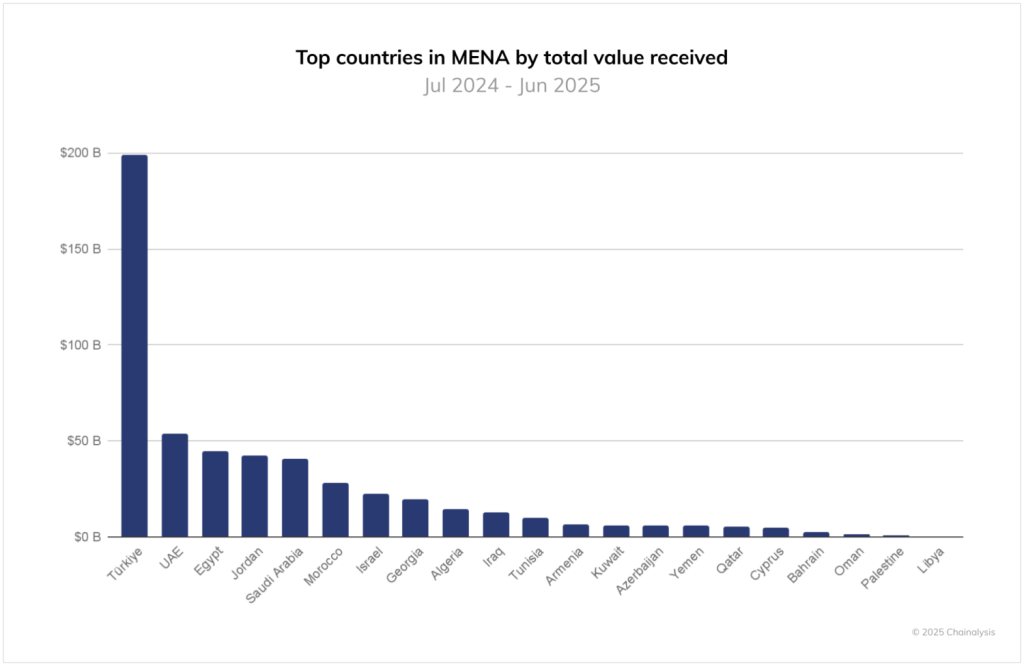
Turkey has become the largest cryptocurrency market in the Middle East and North Africa, recording nearly $200 billion in annual transactions according to new data from blockchain analytics firm Chainalysis.
Turkey’s transaction volume exceeds that of all countries in the region and is almost four times the volume of the UAE, which ranks second with $53 billion.
Despite this rise, analysts caution that much of Turkey’s crypto activity appears to be driven by speculation and does not represent a case of sustainable adoption.
From individuals to institutions: Chainalysis maps the evolution of the cryptocurrency sector in Türkiye
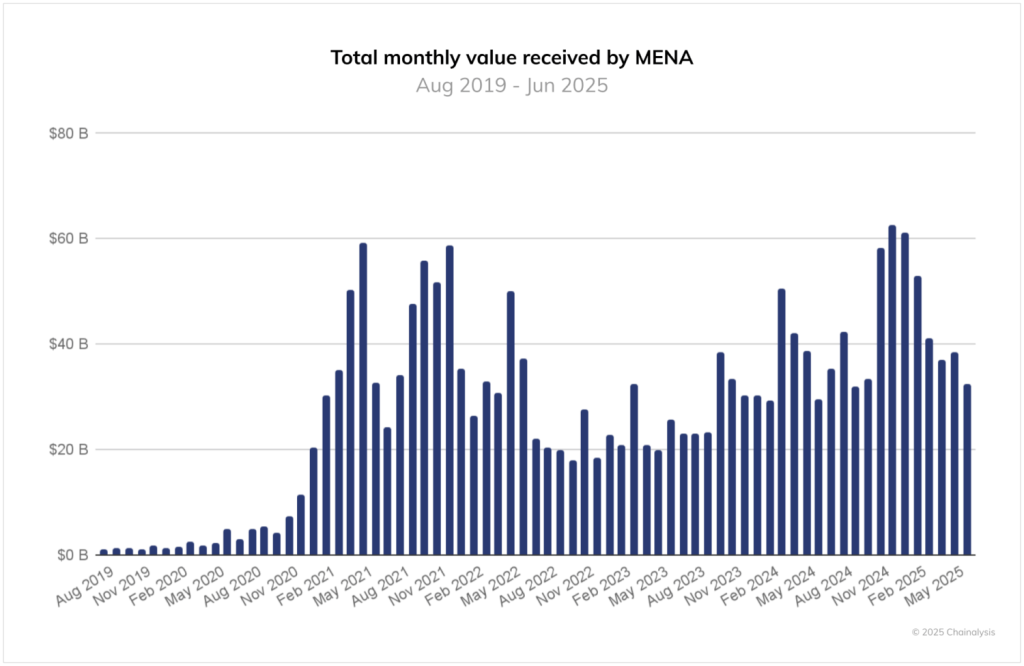
Chainalysis’ 2025 Cryptocurrency Adoption Report shows Turkey’s growing influence in the MENA region, after total cryptocurrency trading volume surpassed $60 billion in December 2024, before declining slightly in 2025.
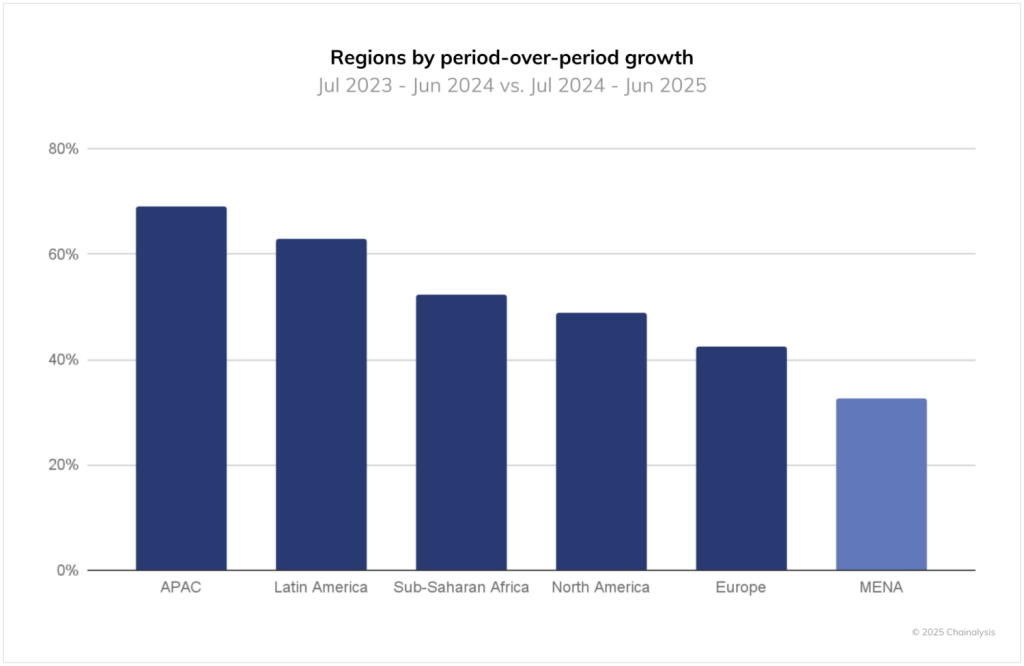
Although the region’s 33% annual growth is still lower than other developing markets such as Asia Pacific (69%) and Latin America (63%), the report reveals a clear trend: the digital currency market in the MENA region continues to grow despite economic instability and political uncertainty.
The case of Turkey constitutes an example here. From early 2021 to mid-2025, the total volume of cryptocurrency movements to Turkey exceeded $878 billion, even though the country suffered a sharp decline in the value of the local currency and still high inflation.
The Chainalysis report also states that digital currencies have become a financial haven for many Turks seeking to preserve their wealth or avoid financial instability resulting from the falling value of the lira. However, the report also warns that the trading structure points to an increasingly speculative market, particularly with retail participation declining, while institutional activity remains strong.
Despite the economic crisis, cryptocurrency activities in the Turkish market have maintained steady momentum, indicating that they have become an effective solution for wealth preservation and speculative trading, but the report indicates a change in participation patterns. Retail activity declined sharply, with the volume of small and large individual transactions falling by 1.6% and 2.3%, respectively.
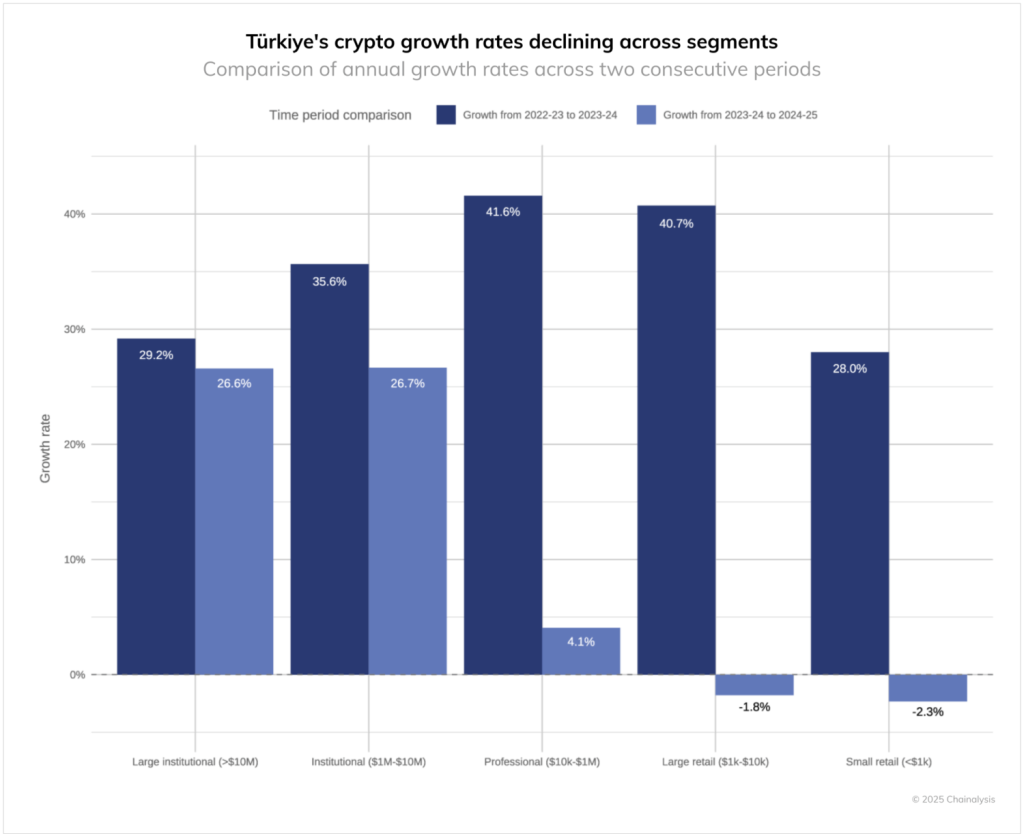
Also, the activities of professional traders have also experienced a sharp decline in growth, falling from more than 40% to only 4% on an annual basis. In contrast, institutional trading activity has proven more resilient as major market participants seek to hedge against inflation and leverage digital assets.
The Chainalysis report attributes the decline to difficulty bearing costs, tightening laws, and declining confidence among small investors after continued volatility in the crypto market.
Stricter standards on “client introduction policy” and transfer caps limit the activities of small crypto traders in Türkiye.
Analysts attribute drop in participation of smaller crypto traders Due to lack of affordability and Turkish authorities’ tightening of laws governing the sector, Turkey tightened its controls on digital currencies in 2024 and 2025 to comply with global anti-money laundering (AML) and Financial Action Task Force (FATF) standards, a move that analysts say has contributed to the decline in participation by small traders.
The new legal framework imposes stricter KYC rules, withdrawal limits and disclosure requirements for cryptocurrency trading platforms, and requires transactions exceeding 15,000 Turkish liras (around $360) to include identifying details and a 20-character description of the transaction.
Turkey strengthens crypto AML regulations! By February 2025, all transactions above 15,000 lira will require user identification.#TurkeyCrypto #AMLhttps://t.co/krSkosCVSs
– Cryptonews.com (@cryptonews) December 25, 2024
Withdrawals that do not include complete sender and recipient information face delays of up to 48 hours, or up to 72 hours for new users.
Authorities also set a maximum of $3,000 per day and $50,000 per month for stablecoin transfers, with higher limits allowed only for service providers that fully comply with the travel rule.
Treasury and Finance Minister Mehmet Şimşek warned that non-compliant companies would face fines, cancellation of their licenses or outright bans.
Turkey has implemented strict crypto oversight with mandatory source verifications and a daily stablecoin limit of $3,000.#Turkey #Regulationshttps://t.co/zDrxu7MOV3
– Cryptonews.com (@cryptonews) June 24, 2025
As part of the new restrictions, the Financial Crimes Investigation Authority (MASAK) has been granted new powers to freeze accounts linked to suspicious activity. In March 2025, Turkey expanded its supervision by amending Law No. 6362 on Capital Markets, to include all cryptocurrency trading platforms, custodian companies and crypto wallet providers subject to the Capital Markets Board (CMB).
Statements III-35/B.1 and III-35/B.2 require platforms to operate as corporations, maintain reserves of at least $4.1 million for platforms and $13.7 million for custodian companies, and submit to audits to prove reserves.
The reforms also established governance and transparency standards, avoided conflicts of interest, and required entities to have mechanisms to protect users, such as dispute resolution systems, clear risk disclosure, and segregation of client funds.
Other reasons that might have led to a decline in the activities of small crypto traders and investors are the exit of big players from the country. For example, cryptocurrency exchange Coinbase withdrew its pre-application to enter the Turkish crypto market, and competitor Binance announced plans to terminate its retail customer referral program in Turkey in accordance with local laws.
Turkey’s digital currency sector continues to thrive despite strict legislation and platform withdrawals
Despite tightening laws and regulations, Turkey remains one of the most active cryptocurrency markets in the world. It ranked 14th globally in the Global Digital Currency Adoption Index for 2025 published by Chainalysis.
The government had previously proposed the idea of imposing a nominal 0.03% tax on transactions in a bid to increase government revenue, but Finance Minister Mehmet Şimşek clarified that profits from digital assets are currently not subject to any tax.
In contrast, Chainalysis’s trading behavior analyzes show that a large portion of Turkish market activity has shifted toward speculative trading of alternative currencies. On the other hand, CCData data revealed that trading volumes increased from around $50 million at the end of 2024 to over $240 million in mid-2025, with alternative currencies outperforming stablecoins as the most traded assets.
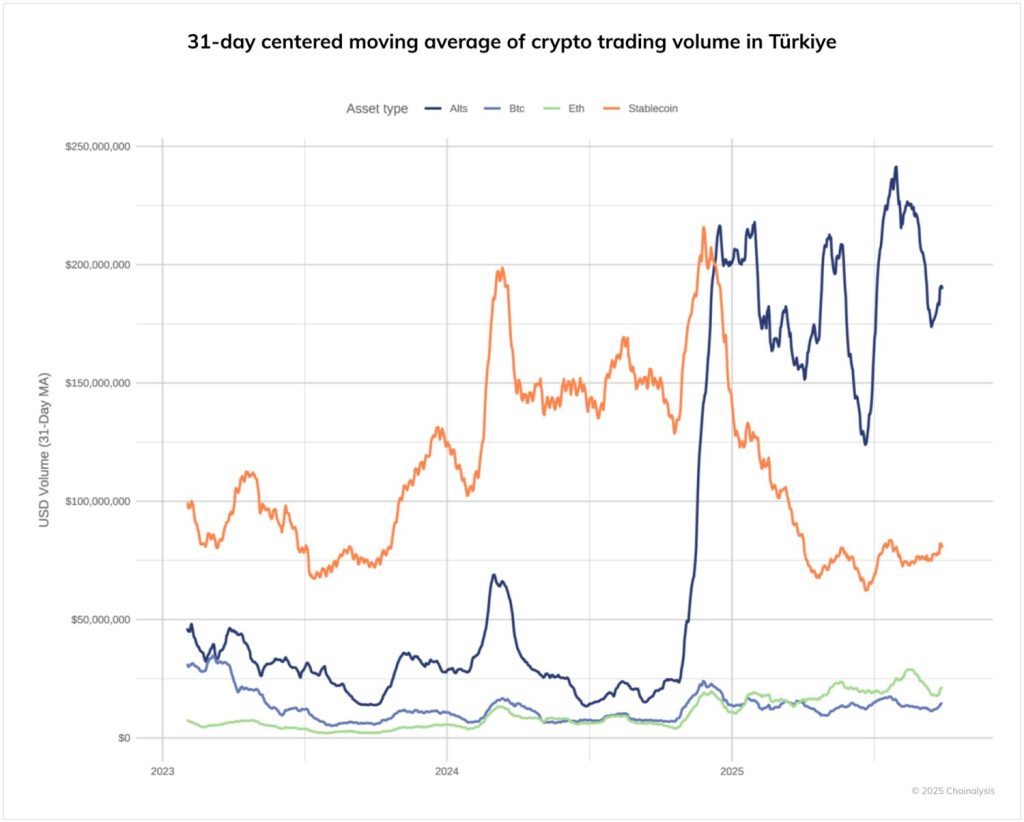
Experts see the trend as an indication of Turkish investors’ willingness to take risks in search of greater profits amid tough economic conditions and tighter regulatory restrictions in the sector.
Regionally, the Middle East and North Africa (MENA) markets show contrasting trends. In the UAE, the digital currency sector continues to grow steadily within a clear regulatory framework, while Israel saw a significant increase in trading volumes after the events of October 2023, as its citizens resorted to digital currencies as a safe financial haven, while Iran maintained a steady pace of growth despite sanctions, relying on an internal technical system almost isolated from global platforms.
The post Türkiye leads the Middle East and North Africa region with $200 billion in crypto transactions, but Chainalysis warns: “It’s just speculation” appeared first on Cryptonews Arabic.

