


Vitalik Buterin, co-founder of the Ethereum blockchain, says decentralized finance (DeFi) has reached an important turning point, as savings on the blockchain are not only feasible, but have begun to compete with traditional banks.
In a pre-recorded speech at a Dromos Labs event on Wednesday, Buterin said he was “optimistic” about the evolution of DeFi on the Ethereum blockchain in terms of security, maturity and ease of use.
He said: “I think we will see increasing growth in the number of people, institutions and all types of users around the world who use the network as their primary bank account… Decentralized finance, as a form of savings, has finally become applicable.
Will DeFi be your next bank account? Vitalik Buterin believes the time has come for this
These statements reflect the great development of a sector which, according to Buterin, is moving from speculation to stability. Decentralized finance (DeFi) based on the Ethereum blockchain was previously associated with high-risk lending, complex profit-harvesting strategies, and frequent protocol mining. But Buterin confirms today that the difference between 2025 and the start of the decentralized finance era in 2019 or 2020 is “perfectly clear”.
While he acknowledged recent hacks, including the multimillion-dollar Balancer hack earlier this month, he emphasized that smart contract security has improved significantly.
On this subject, blockchain analysis firm Elliptic reported that although cryptocurrency losses in 2025 are technically “dwarfed” compared to last year’s losses (i.e. much larger), a significant percentage of this figure is due to the historic hack of the Bybit platform in February, and not to the structural weaknesses of decentralized finance.
Buterin emphasized “withdrawal testing,” a simple DeFi security measure that ensures users can always recover their funds independently. Buterin urged developers to keep the founding principles of the Ethereum blockchain at the heart of their activities: open source, interoperability and censorship resistance.
He also called on application developers to build applications that take into account both the Ethereum mainnet and Layer 2 networks. With new tools like Lighter, which has surpassed 10,000 transactions per second, Buterin sees scalability improving across Layer 1 and Layer 2 networks. “With the right engineering, this level of expansion will allow everyone to start their own development today,” he added.
Of note, the Ethereum blockchain’s decentralized finance (DeFi) system processed over $1.9 trillion in transactions during the quarter and includes a market worth $77 billion and over 312 million active users as of mid-2025.

On the other hand, average decentralized finance (DeFi) savings returns hover around 8.2%, compared to around 2.1% in traditional banks.
Although DeFi’s operational costs are low, the sector still faces persistent risks, including fraud and hacking which cost $1.1 billion in the first half of 2025.
In contrast, global traditional banks manage around $370 trillion in assets and process $405 trillion per quarter, but slow settlements and high fees make the decentralized financial system (DeFi) – which does not require special permissions – more attractive to users seeking independence and speed.
The Ethereum blockchain goes back to basics with Buterin’s “No Trust Statement”.
Buterin’s optimism follows a paper he published in September touting the “low-risk” properties of decentralized finance as a sustainable economic backbone for the Ethereum blockchain, a form of decentralized banking that could power the network much as Google’s search engine powers Google’s technical ecosystem.
Buterin believes that lending stablecoins and flat coins tied to inflation indices or currency baskets could contribute to the stability of Ethereum’s blockchain economy while preserving its value.
Buterin pointed out that major DeFi protocols like Aave, which offer stablecoin yields of around 5%, offer the kind of low-risk funding that Ethereum aspires to.
Earlier yesterday, Buterin and the Ethereum Foundation released a “No Trust Statement,” warning developers not to sacrifice decentralization for convenience.
The paper criticizes trends such as centralized organizers in Layer 2 networks and hosted remote answer point (RPC) nodes, arguing that “decentralization is not destroyed by data breaches, but by the preference for practical solutions.”
The document proposed three “laws” for a design that did not require third-party trust: no sensitive secrets, no exclusive intermediaries, and no unverifiable results.
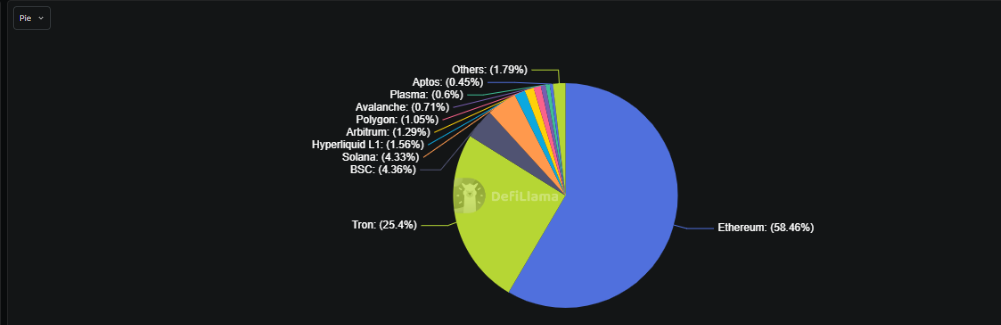
On the other hand, the Ethereum network continues to strengthen its technical and institutional foundations and today hosts more than 75% of digitally represented assets and 58% of the global supply of these assets, with companies such as BlackRock, Securitize and Ondo Finance launching digitally represented treasury products on this network.
Layer 2 networks built on the Ethereum blockchain now secure over $50 billion in value, while work on privacy and expansion has accelerated thanks to the Ethereum Foundation’s new 47-member Privacy Group.
The article Vitalik Buterin: Decentralized finance (DeFi) on the Ethereum blockchain now competes with banks, and economies on the blockchain are finally safe appeared first on Cryptonews Arabic.

