


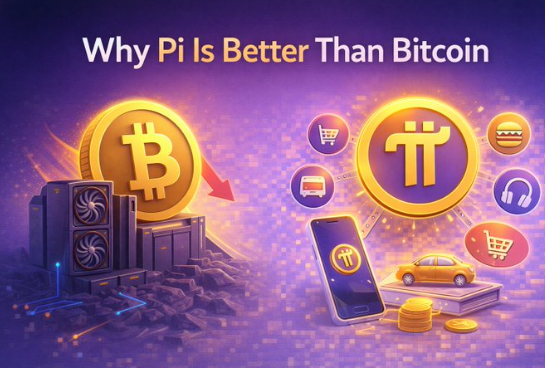
Why Pi Network Could Overtake Bitcoin in Daily Usage and Accessibility
In the rapidly evolving world of cryptocurrencies, Bitcoin has long been celebrated as the first decentralized digital currency and a store of value. However, recent discussions among cryptocurrency enthusiasts, including insights from @justicechibueze, suggest that the Pi Network may offer a more practical and accessible alternative for everyday users. Unlike Bitcoin, which is primarily considered an investment vehicle, Pi is designed for real-world usability, inclusivity, and energy efficiency, making it a strong contender for widespread adoption.
Accessibility and inclusion
One of the key limitations of Bitcoin lies in its accessibility. Bitcoin mining requires specialized hardware, high computing power, and significant energy consumption. This has created barriers for everyday users who want to participate in the network. Bitcoin mining is expensive, competitive, and often dominated by large institutional players.
Pi Network, on the other hand, allows anyone to participate using a standard smartphone. This low barrier to entry democratizes the mining process, allowing users from all over the world, regardless of their economic situation, to contribute to the network. The simplicity of Pi mining fosters a sense of inclusivity and community ownership that is difficult to achieve with Bitcoin.
Energy Efficiency and Environmental Impact
Another important distinction between the Pi Network and Bitcoin is their environmental footprint. Bitcoin mining consumes enormous amounts of electricity, contributing to environmental concerns and raising sustainability issues. Estimates suggest that Bitcoin’s energy consumption rivals that of some entire countries, making it an increasingly controversial asset in a world focused on sustainable development.
Pi Network is designed to run efficiently on mobile devices without high power consumption. By eliminating the need for energy-intensive mining rigs, Pi not only reduces its environmental impact but also positions itself as a forward-thinking cryptocurrency aligned with global sustainability trends.
Designed for everyday use
While Bitcoin has gained recognition as a store of value, it is less practical for everyday transactions due to slow processing times and high transaction fees. For everyday payments, purchases of goods, or transferring funds between people, Bitcoin can be cumbersome and expensive.
Pi Network, on the other hand, is designed with practical utility in mind. Its infrastructure is designed to facilitate real-time transactions, allowing users to use Pi for daily activities such as online payments, peer-to-peer transfers, and participation in decentralized applications. By prioritizing usability, Pi positions itself as a currency that can truly integrate into the daily lives of everyday people.
Community Driven Growth
Pi Network’s growth is driven by its community, known as Pioneers. Unlike Bitcoin, where mining and governance can be dominated by large stakeholders, Pi emphasizes collective participation and collaboration. Users earn Pi through active participation, network validation, and referral programs, reinforcing a community-driven approach.
This model encourages long-term commitment, builds trust, and ensures that the network develops in line with the needs of its users. By placing an emphasis on community and real-world participation, Pi builds a resilient ecosystem that is both decentralized and user-centric.
Pi as money, not just an asset
A key philosophical distinction between Pi and Bitcoin is their intended function. Bitcoin is widely regarded as a digital store of value, often compared to gold. It is an asset that is kept for appreciation and not for regular use. Pi, however, is designed to work like real money.
Each mined Pi is intended to be spent, traded, or used within the network’s application ecosystem. This practical orientation makes Pi a functional medium of exchange and not simply an investment vehicle. For everyday users, this translates into real utility and tangible benefits in everyday financial transactions.
Bridging Web3 and widespread adoption
The design of Pi Network aligns closely with Web3 principles, focusing on decentralization, accessibility, and digital sovereignty. By allowing users to mine, transact, and develop applications on a mobile platform, Pi encourages widespread adoption and integrates blockchain technology into everyday life.
Additionally, Pi’s infrastructure supports the creation of decentralized applications (dApps) and services that leverage its internal economics. This creates opportunities for users to participate in a broader digital ecosystem while using Pi as their primary currency, bridging the gap between blockchain innovation and general usability.
 |
| Source: Xpost |
Lower barriers, higher participation
By reducing technical and economic barriers, the Pi Network allows for a higher level of participation compared to Bitcoin. Anyone with a smartphone can become part of the network, facilitating global adoption, particularly in regions where access to traditional banking or cutting-edge technology is limited.
This inclusion also encourages diverse innovation. Developers and users around the world can propose, create, and interact with applications that expand the Pi ecosystem, creating a self-reinforcing cycle of growth, adoption, and utility.
Security and Decentralization
While affordable and energy efficient, the Pi Network also maintains the security and decentralization principles crucial to blockchain technology. User transactions and contributions are verified through consensus mechanisms that protect the integrity of the network while avoiding excessive energy demands associated with Bitcoin mining.
Decentralization is further enhanced by community participation. Pioneers collectively validate the network, ensuring that control is distributed rather than concentrated among a few entities. This approach preserves trust and strengthens network resilience.
Potential economic and real-world use cases
The Pi Network’s design emphasizes economic utility. Unlike Bitcoin, which often functions primarily as a speculative asset, Pi is integrated into applications, peer-to-peer transactions, and commerce. Users can send and receive Pi, pay for digital goods, and participate in network-driven initiatives that provide real-world value.
This focus on usability positions Pi to potentially achieve broader adoption than Bitcoin as a currency for everyday transactions. By creating a network where digital money has practical purposes, Pi can become a foundation for financial inclusion and economic participation.
Challenges and considerations
Despite its advantages, the Pi Network faces similar challenges to other emerging cryptocurrencies. Regulatory frameworks, market adoption and maintaining network integrity are constant considerations. However, its focus on accessibility, energy efficiency, and practical utility sets it apart from Bitcoin and provides a compelling argument for its widespread use.
The success of the network will depend on continued user participation, the development of applications that leverage Pi, and sustained global interest in digital currencies for practical purposes rather than solely speculation.
Conclusion
The Pi Network presents a compelling alternative to Bitcoin by addressing critical limitations such as accessibility, power consumption, and practical usability. Unlike Bitcoin, which primarily functions as a store of value, Pi is designed for everyday people and offers a functional digital currency for real-world transactions.
Through mobile-friendly mining, energy efficiency, community-driven growth, and a focus on practical utility, Pi is positioned as money rather than simply an investment. Its design aligns with Web3 principles, enabling decentralized participation while fostering real economic value.
For users, developers and pioneers, the Pi Network represents a step towards a more inclusive, accessible and practical cryptocurrency ecosystem. By bridging the gap between blockchain innovation and everyday usability, Pi demonstrates that digital money really can be for everyone, redefining the concept of currency in the 21st century.
hokanews – not just cryptocurrency news. It’s cryptoculture.
Writer @Victory
Victoria Haleis a pioneering force in the Pi Network and a passionate blockchain enthusiast. With first-hand experience setting up and understanding the Pi ecosystem, Victoria has a unique talent for breaking down complex developments in the Pi Network into engaging, easy-to-understand stories. It highlights the latest innovations, growth strategies, and emerging opportunities within the Pi community, bringing readers closer to the heart of the evolution of the crypto revolution. From new features to analysis of user trends, Victoria ensures that each story is not only informative but also inspiring for Pi Network enthusiasts everywhere.
Disclaimer:
HOKANEWS articles are here to keep you up to date on the latest rumors in crypto, technology, and more, but they are not financial advice. We share information, trends and knowledge, we don’t tell you to buy, sell or invest. Always do your own homework before making any money moves.
HOKANEWS is not responsible for any loss, gain or chaos that may occur if you act on what you read here. Investment decisions should arise from your own research and, ideally, the guidance of a qualified financial advisor. Remember: cryptocurrencies and technology move fast, information changes in the blink of an eye, and while we strive for accuracy, we cannot promise that it is 100% complete or up-to-date.

